Wednesday, August 18, 2010

Silver Creek License Plates

Silver Creek intern Dominique Lucio put together this collage of license plates he saw on the preserve this summer. It's obvious that our visitors love their fish and birds--and the preserve!

If you have other photos of creative nature- and outdoors-related license plates, let us know, and we'll post them on the blog.

Monday, August 16, 2010

Silver Creek Fishing Report - August 16, 2010

Submitted by Dayna Gross, Silver Creek Preserve manager

The tricos are finally here!

For a while there were sporadic hatches around 8:30 or 9 am. followed by a baetis (size 20-22) or PMD (size 14-18) hatch until a few days ago when we saw the first full trico hatch.

A little late and a little odd, but this summer has not been typical as far as weather. The late afternoon thunderstorms have mixed things up and many people have given the mice patterns (or vole patterns!) late at night a try-- the brown trout are definitely getting fat this year. With a late or mid afternoon wind, grasshoppers are a sure thing.

The preserve has not seen many visitors the past two weeks, so your luck may be increased with the low traffic.
Vole Update: We've covered these little rodents quite a bit this summer. The Idaho Statesman has another interesting bit of info about this year's vole explosion. It turns out that not only are voles feeding many species from trout to raptors, they're also reducing the amount of grasses in sagebrush country--leading to a decrease in size and frequency of fires. Way to go, voles!

Monday, August 09, 2010

Vole Patrol

Voles, voles, everywhere.

As the Idaho Mountain Express reported last week, much of southern Idaho is experiencing a vole population explosion this summer.

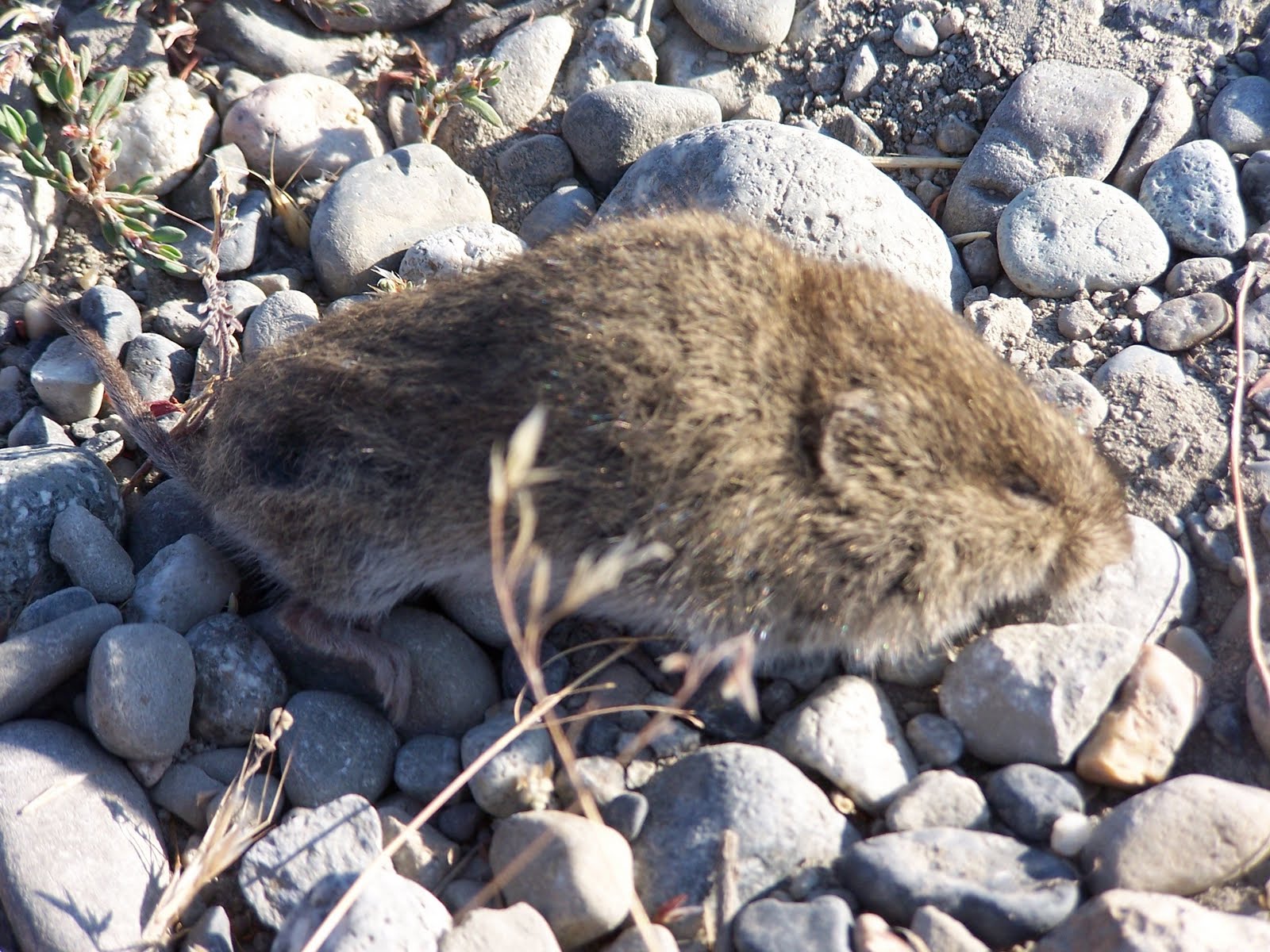
Montane voles are small but stocky rodents that live in large colonies. You might see them scurrying across the road or trail. Or you might notice their well-developed trails through sagebrush, meadows and agricultural fields.

Some reports point to this vole abundance as a sign of nature "out of balance," an assertion that is not correct.

Voles populations are cyclic, and at times the little animals exist in staggering numbers.

And wherever there are large numbers of prey animals, there will be a lot of predators taking advantage of the situation. Whether it's wildebeest in the Serengeti, mayflies on a spring creek, or snowshoe hares in the Arctic, huge masses of prey invite a feeding frenzy.

And that's certainly the case with high vole populations. So many predators eat voles--foxes, coyotes, hawks, owls, weasels, snakes. And, oh yes, trout.

Visit Silver Creek in the evening and note the high numbers of owls around. It would be interesting to know if the owls have more young, or raise young more succesfully, in years of peak vole abundance. In Alaska, lemming population booms mean more breeding by snowy owls and short-tailed weasels. Perhaps voles--which are similar to lemmings--affect Idaho predators' survival and breeding success.

The concept of the "balance of nature" makes a good story, but it's never really been accurate. Nature sometimes appears, to human eyes, to be wildly out of balance. But huge population outbreaks are not necessarily plagues or natural disasters; instead, they're merely part of a natural cycle of prey and predator.

This summer, keep an eye out for voles and the many animals that eat them. It may be a while before we ever see this many again.

Friday, August 06, 2010

Puffball

On a recent trip into the Owyhees, the Conservancy's director of science, Bob Unnasch (left) and director of stewardship, Art Talsma (right) located this giant puffball--the largest either had ever seen.
It's an impressive example of a common and widespread group of fungi species.
Puffballs consist of a number of groups of fungi, with the notable feature being that they produce their spores internally. The puffballs eventually dry up and split, whereupon their spores are released into the breeze.
This is what gives them their name. Anyone who has stepped on a dried puffball is familiar with the "puff" of spores that explodes from the puffball--almost like smoke.
This particular puffball will no doubt emit a large cloud of spore "smoke." In the meantime, though, it looks pretty good modeling a Nature Conservancy hat...

Monday, August 02, 2010

Really Big Trout

To start the week, here are two big fish photos from our Idaho preserves. The above photo was taken at Flat Ranch Preserve, on the headwaters of the Henry's Fork in Macks Inn.

The Henry's Fork Foundation recently conducted an electro-shocking survey of a stretch of the preserve's waters where a habitat restoration project was recently completed. The 24-inch Yellowstone cutthroat is one of the fish they caught and released during the survey.

The Henry's Fork Outlet that runs through Flat Ranch is not very big water. Most would not guess it holds fish like this.

The Yellowstone cutthroat is the native fish of these waters, and is imperiled due to the usual enemies of native trout: loss of habitat and competition from non-native fishes. It's great so see these fish still surviving on the Flat Ranch. The habitat restoration offers a hopeful future for these beautiful fish.
And here's a fish caught--by fly fishing, not electro-shocking--by the Conservancy's East Idaho conservation manager, Chet Work, on Silver Creek Preserve.
Chet recently accepted the position of executive director for the Teton Regional Land Trust, so we like to think of this as his going-away present.
Words like "passion" and "obsession" don't quite capture Chet's enthusiasm for fishing. This is someone who, quite literally, sets hooks in his sleep. He has spent some late nights chasing the monster browns of Silver Creek.
And while he's not saying what fly caught the trout, another recent Silver Creek blog post might hold a clue.
Having snorkeled much of the preserve last week, I can also assure you that I saw plenty of other behemoth trout--including a few that could pass for this one's "big brother"--swimming the waters.
They're out there, lurking beneath the surface. We'd love to see your photos if you have any luck.
In the meantime, we'd like to again take this opportunity to thank Chet for his five outstanding years with the Conservancy, and wish him the best as he continues to work towards protecting Idaho's most special places.
Cutthroat trout photo by Flat Ranch Preserve intern Bryan Kloster.

Wednesday, July 28, 2010

See Bear Run

A new column in the Spokane Spokesman Review's Down to Earth publication focuses on conservation in northern Idaho and eastern Washington.

The first installment explains why working forests are a key component of the continued survival of grizzly bears in the Idaho Panhandle.

Monday, July 26, 2010

Ball Creek Ranch Preserve, and Beyond

I had long wanted to share in the mission of The Nature Conservancy, to work to protect the rich biodiversity of this planet through pragmatic conservation.

In June 2005 the opportunity presented itself when I was hired as the preserve manager at the Conservancy’s Ball Creek Ranch Preserve in the Kootenai River Valley of north Idaho.

Five years later, I can say that it has been one of the most rewarding and challenging experiences of my life.

I feel fortunate to have had the opportunity to live and work in such a remarkable place, to have developed sound relationships with conservation partners and to have worked alongside them to protect and restore important wildlife habitat.

Under the leadership of Robyn Miller, the Conservancy’s North Idaho conservation manager, the North Idaho program has realized tremendous conservation outcomes that benefit both people and wildlife.

I have never worked around a more talented and devoted group of people than those working for the Conservancy in Idaho.

I recently took a new position with the Conservancy, and on August 9 I will begin working as associate director of philanthropy.

This, of course, is quite a shift from the calling that originally led me to Idaho. I will be relocating to Hailey, in order to conduct business from our state office, and while I will certainly miss North Idaho, I look forward to the new experiences that this opportunity will provide.

My time at Ball Creek Ranch has left me with a wealth of memories to draw from…. summer sunsets over the valley, a sky full of migratory waterfowl, and some interesting interactions with moose and bear!

Since purchasing the Ball Creek Ranch, the Conservancy has restored more than 500 acres of wetlands and associated habitat, and set aside several hundred additional acres for wildlife protection.

Much of the property has remained in agricultural production. Ball Creek Ranch is a unique and complex project that successfully meets the needs of wildlife and people.

I greatly value the time I’ve spent at Ball Creek and look forward to seeing the success story more fully develop in years to come.

Justin Petty
Inland Northwest Land Steward, The Nature Conservancy
Photo: Rider, Justin Petty, Robyn Miller

Monday, July 19, 2010

The Wild & Scenic Bruneau

The Nature Conservancy’s Will Whelan recently joined friends on a four-day float trip down the Bruneau River in southwest Idaho. He brought back photographs of one of the most stunning and remote canyons in Idaho.
Will has a special link to the Bruneau because he has spent the last several years working with the Owyhee Initiative, a collaborative effort with ranchers, county government, Shoshone-Paiute Tribes, conservationists and recreationists dedicated to improving public lands management in this five million-acre corner of Idaho. Last year, the Owyhee Initiative worked with Senator Mike Crapo to pass federal legislation that designated the Bruneau Canyon a wilderness and wild & scenic river. This was Will’s first visit to the Bruneau since these new protections were enacted into law.
The Bruneau’s steep walls create a shady and relatively cool oasis along the river. The canyon bottoms support surprisingly lush plant communities, including the Bruneau River prickly phlox, a cliff dwelling flower that exists only here. The canyon is also home to the reclusive canyon wren, which serenades visitors with its distinctive descending scale of notes. Most boaters stay close to the water, but numerous side canyons offer rugged hikes that lead to caves, slot canyons, and vast desert tables high above the river.
The easiest way to see the Bruneau Canyon is from the scenic overlook a short drive off of the Bruneau-Three Creek Road, about twenty miles south of the town of Bruneau. The overlook is perched on the edge of the canyon and provides a breathtaking view nearly 1,000 feet straight down to the river below. Floating the Bruneau during the short boating season in late spring involves long hours of travel over rough roads and challenging Class IV rapids.

Wednesday, July 14, 2010

Jaws: Silver Creek Edition

Thirty-five years ago this summer, Jaws caused many people to pause before they stepped into the water.

But Silver Creek? Who would be afraid to jump into Silver Creek? No one, of course.

Unless you happen to be a vole.

During ongoing fish surveys at Silver Creek, the Idaho Department of Fish and Game killed a few fish to sample growth and health of the population.

A look at fish stomach contents might surprise those who spend their days casting dainty mayfly imitations to rising trout.

Voles.

The above rodents were pulled from trout stomachs.

Montane voles are an abundant animal throughout the Intermountain West, small rodents that make well-defined paths as they forage. They're prone to periodic population explosions.

This is such a year at Silver Creek. And the trout have obviously keyed in on them, much as they would a mayfly hatch.

I've always heard that trout will take small rodents along the creek, and I know some large trout are caught on deer hair mouse flies. Still, I always considered these to be a "fishing tale," something that may happen on rare occasions, but hardly a regular occurrence.

Well, here's the proof. For voles, it really isn't safe to go back in the water. --Matt Miller

Photo by Ralph Stewart

Monday, July 12, 2010

July 12, 2010: Silver Creek Fishing Report

Submitted by Dayna Gross, Silver Creek Preserve manager

Fishing through the preserve continues to be challenging but good. The hatches have been sporadic, especially following the cold spell last week.

Mid-morning hatches of pale morning duns (PMDs) continue (size 14-18) as well as flurries of Baetis throughout the day (size 20-22). The blue damselflies have appeared in the past week as well as an occasional trico.

Green drakes are also occasionally seen and can be productive throughout the day.

The trico hatch (trico mayflies on hat pictured above) should start any day now with this warm weather; come early with tiny flies and fine leaders if you want to test your angling skills on one of the most profuse yet toughest hatches in the West.

The preserve has been really quiet with the Big Wood becoming fishable last week (and very good I hear). We are seeing few visitors in the mornings right now with many people coming down in the evenings when things cool off a bit.

There have been many reports of moose and one of a black bear—so be careful out there!

Thursday, July 08, 2010

Flat Ranch Preserve Update

Flat Ranch Preserve, located in Macks Inn just 15 minutes from West Yellowstone, makes a great stop if you're on a trip to Yellowstone, the Henry's Fork or Henry's Lake. The preserve is open to the public for fly fishing, hiking, birding, wildlife watching and other outdoor recreation. There are also numerous lectures and events throughout the summer.

This year's preserve manager, Christopher Little, submits the following report on what's been happening on the preserve.
Birding Tour (June 23) - Jill and Neil Bachman were two excellent volunteers who helped out here for more than a month. Along with their passion for conservation and traveling, Jill and Neil are excellent birders, and they agreed to lead a bird tour here on the ranch to kick off our 2010 summer speaker series. The birding tour was a success and the weather cooperated. Several of the birds we saw were bald eagle, long-billed curlew (above), sandhill crane, swainson's hawk, American pipit, lesser scaup, California gull, and tree swallow. Thanks for everything Neil and Jill!
Flower Tour (June 26) - The flowers were incredible this season. Klara Varga, a botanist and flower expert from Ashton, , came to the Flat Ranch and lead a flower tour on the property. With a small class size, participants were treated to a detailed and scientific analysis of the diversity of flowers blooming on the Flat Ranch. It was a spectacular event, both educationally and aesthetically. The sun was shinning and the flowers were everywhere. Several of the flowers we identified were mule's ear, larkspur, groundsel, prairie smoke, blue camas, American bistort, sinkfoil, shooting star, and purple violet. Everyone came away from this class with a great amount of knowledge. Thanks Klara for a great class!
We will have many other events this summer at the preserve. The schedule for August and September will be posted on this blog soon. Cattle arrive (June 29) - We received more than 250 pair (cow and calf) to start the grazing season. They will be rotated throughout the 14 pastures at the ranch through October using intensive, short rotation periods. Their presence on the ranch exemplifies how habitat protection and proper grazing techniques can work together to achieve conservation goals. We have real cowboys out here managing the herd and protecting critical habitat for cattle and wildlife alike.


Tuesday, July 06, 2010

Idaho State Parks Pass: Buy On-line

You can now buy your Idaho state parks pass on-line.

For $40, the parks pass entitles you to unlimited day use at all of Idaho's state parks, valid through December 31.

Fly fish world famous waters at Harriman, hike along clear blue waters at Box Canyon, cross country ski at Ponderosa, walk along the Oregon Trail at Three Island Crossing, climb at Castle Rocks or picnic at Lucky Peak: all covered by the pass.

Buying a pass also shows your support for our parks during difficult budget times. It's your ticket to summer fun--and a great help for conserving our state's treasures.

Photo: Bruneau Dunes State Park, home to the tallest single dune structure in the United States. Photo by Phares Book.

Wednesday, June 30, 2010

Ernie the Elk Roams Again?

Blog readers from the Treasure Valley probably know the story of "Ernie the Elk," a large bull elk that--for reasons known only to him--decided to live among a herd of cattle along the Boise Greenbelt.

Ernie became a popular attraction along the Greenbelt. For two years, he lived among the cattle.

Last fall, he returned to the foothills, where a hunter allegedly shot him. This set off a fury of letters and controversy in the Idaho Statesman.

Tonight, as I jogged along the Greenbelt, I thought I saw a ghost. A very large bull elk suddenly bolted into cover as I ran.

Has Ernie returned? Has another bull elk taken his place? Was this just a random elk passing through?

Of course, we'll never know for sure. Perhaps more important than the individual elk, though, is the fact that we live in a state where such wildlife sightings are still possible.

Running along the Greenbelt in Idaho's largest city, I've seen river otters and beavers and long-tailed weasels and mule deer. Herds of pronghorn and elk roam the foothills.

Farther afield, there are bighorns and grizzlies, even caribou.

You never know what you might see when you go out for a hike or jog.

It's one of the important reasons why we live here. But as more people call Idaho home, we have to find a way to conserve wildlife habitat, so that future generations can still marvel at bull elk on their jogs.

As for "Ernie"? I won't reveal exactly where I saw him, for reasons that should be obvious. But if you're along the Greenbelt this weekend, look carefully. There's a bull elk out there. --Matt Miller

Monday, June 28, 2010

Back Underground

Take a walk during the spring or early summer in many parts of southern Idaho and you'll see ground squirrels scurrying around.

And then, around this time of year, they disappear.

Where do ground squirrels go?
Much is made of Punxsutawney Phil's emergence each year; the groundhog's emergence from a den is viewed as a sign of spring. But, in warm areas (like southern Idaho), ground-dwelling rodents return to their dormancy--not when it gets too cold, but when it gets too hot.
Hibernation and torpor are ways of conserving energy. Finding food and staying warm in the winter requires a lot of calories: more than most ground-dwelling squirrels can muster.
Staying cool also takes a lot of energy.
For several species of Idaho ground squirrels, that means they are above ground for very short periods of time.
For instance, take the Columbia ground squirrels so common around Silver Creek. They emerge in mid- to late-April. And then, in early July, they return to their burrows for a very long dormancy. Sometimes they reemerge for a short period in the autumn. Other times they don't re-emerge until April.
It boggles our human notions of time to imagine a species that is dormant for 8 or more months each year of its life.
Yellow-bellied marmots in the cool Idaho Rockies will remain active through the fall. In southern Idaho, many go into dormancy beginning in July.
Idaho is home to 19 species of the squirrel family--9 ground squirrels, 5 chipmunks, 2 marmots, 2 native tree squirrels and 1 non-native squirrel. One of them, the aptly named Idaho ground squirrel, is only found in this state. To most, a "ground squirrel is a ground squirrel," but they can be fascinating animals to observe.
In fact, this spring I hosted two mammal watchers who traveled to Idaho (one from France) specifically to see different species of ground squirrels. Mammal watching may not be as popular as birding, but its enthusiasts are just as as passionate.
Take some time to check out the ground squirrels. But go now, because many will soon be back underground, hibernating for another eight months.
Photos: (Top to bottom) Columbia ground squirrel, Silver Creek; Idaho ground squirrel, Emmett; Piute ground squirrel, Snake River Birds of Prey area. Photos are by my friend Jon Hall, who has seen more wild mammals around the world than anyone. See his web site Mammal Watching for trip reports and stories from wildlife travels around the globe.

Thursday, June 24, 2010

Flight of the Nighthawk

Peent, peent: It's summer, and the nighthawks fly overhead.

During the day, the common nighthawk blends in on the ground or tree branches where it rests. Come evening, these interesting birds put on one of the best aerial displays around.

For some reason, I think they look a bit like boomerangs as they glide over rivers, ponds, city parks and even downtowns.

As they fly, they gobble up mosquitoes, caddis flies and other insects.

Common nighthawks spend the summer in Idaho before migrating to South America for the winter. They are common and adaptable birds, but even they depend on a wide range of protected habitat on a migration stretching over two continents.

At dusk, they're quite easy to spot overhead, and even easier to hear. Their nasal peent carries well. (Listen).

We've all experienced those sounds or songs that transport us back to another time in our lives. For me, every time I hear the call of the nighthawk, I travel back to Penn State, where I worked for several years as a writer and editor at the performing arts center.

It's a muggy Pennsylvania summer evening: I'm tired after a day of deadlines and copy editing. Something stops me as I walk across the now quiet and deserted campus. There: overhead, nighthawks circle around Old Main, catching moths and other insects drawn to the lights.

Those pressing deadlines and publications and edits will wait, and in the last evening light there are only those birds, and their calls. Peent, peent. -- Matt Miller

Photo by Gavin Keefe Schaefer under a Creative Commons Attribution 2.0 Generic license.

Monday, June 21, 2010

Electro-fishing

Recalling his first fishing trip to Silver Creek, Jack Hemingway wrote "I suspected there was something going on that I simply didn't understand"--a sentiment familiar to many anglers.

Spring creeks like Silver Creek are complex ecosystems. Even a careful observer can only hope to catch an incomplete glimpse of what's really happening.
That's why monitoring and research are such an important part of the Silver Creek conservation program. Spring creeks are not well studied. But at Silver Creek, a substantial monitoring program supplies biologists with a more complete picture.
From birds to vegetation, from water temperatures to flow rates, monitoring programs regularly assess the state of the creek.Beginning in 1997, the U.S. Geological Survey (USGS) has monitored fish populations in Silver Creek every three years.

This year, USGS biologists, with assistance from the Idaho Department of Fish & Game and Conservancy interns and volunteers, are electro-shocking sections of the creek to conduct their survey. Electro-shocking sends an electric current through the water which stuns any nearby fish. Volunteers net the fish, which are then delivered to live wells.

Fish species are recorded, and each fish is then weighed and measured, before being carefully released back to the stream. Anglers and conservationists are always very interested to know the ratio of rainbow trout to brown trout. There has been some evidence that brown trout, a Eurasian species, have slowly been taking over as the dominant species.

During Monday's electro-shocking, biologists were surprised at the large number of healthy rainbow trout. But it's far too early to guess what the monitoring studies will find.Trout aren't the only focus of this study; biologists also record the presence of dace, sculpin and the other small fish species that often escape notice. USGS biologists are also recording large invertebrates as part of the monitoring survey.

These smaller species are an integral part of the Silver Creek ecosystem--and serve as indicators as far as water quality and the overall health of the creek.

The electro-shocking will continue through July. In early autumn, the Conservancy will receive the results of this year's monitoring. We'll post the information here, so check back for the most current information on Silver Creek's fish.

Thursday, June 17, 2010

Camas Bloom

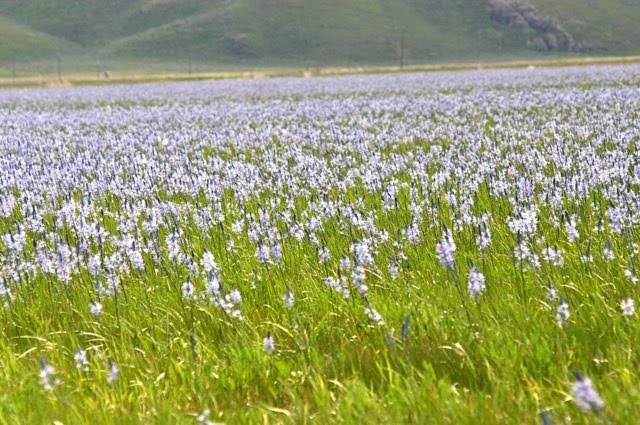
Nature Conservancy volunteer Ken Miracle sent these photos from his recent outing to the Camas Prairie and Centennial Marsh, located along Highway 20 near Fairfield.
The camas are in full bloom now, cloaking wet meadows in light blue. These beautiful meadows were also appreciated by the Lewis and Clark expedition in 1804; Meriwether Lewis described said one such meadow “resembles lakes of fine clear water.”

But the camas was more than a pretty flower for Lewis and Clark. They learned from American Indian tribes why camas bulbs were an important staple.

The bulbs were roasted in earthen ovens, and dried into cakes that could be eaten throughout the winter. Some tribes even cultivated camas. You can still ocassionally sample camas today, often at events like Camas Lily Days in Fairfield. A great place to check out the camas bloom is the Centennial Marsh, an area The Nature Conservancy helped protect that is today a wildlife management area owned by the Idaho Department of Fish and Game.
The Centennial Marsh is also a fantastic place for birding, especially during moist years. The marsh and surrounding areas contain large numbers of nesting waterfowl, shorebirds, sandhill cranes and raptors.

Ken Miracle photographed the avocet (above) and northern shoveler (below) last weekend.
The flowers are peaking, so check out the Camas Prairie this weekend for a "birds and blooms" outing.

Monday, June 14, 2010

Silver Creek Fishing Report, June 14

Submitted by Dayna Gross, Silver Creek Preserve manager

This spring weather has really given us a run for our money at Silver Creek. The usual pale morning dun (PMD) hatches are happening--- but throughout the day and seemingly at random. I saw an enormous PMD hatch (size 16-18) on upper Silver Creek (upstream of the visitor center) around five o’clock last night.

Other reports have the hatch happening around 10:30 or 11:00 am.

Baetis (size 20-22) appear throughout the day.

The word at the visitor center is that the brown drakes started last night. There was a thick hatch at the Picabo bridge about 10:30 p.m. and there were a few sparse flies near point of rocks.

I met up with the US Geologic Survey today, who just happened to be doing macroinvertebrate surveys at the the Idaho Department of Fish and Game's willows access and they said the creek was loaded with brown drakes.

I suppose that may be considered inside information, but when it comes to the brown drakes—take what you can get. Tonight may be the night!!

Thursday, June 10, 2010

Waiting for Brown Drake, 2010

The brown drake hatch on Silver Creek is simply spectacular: It's the one time of the year when the fishing does not require micro-thin leaders, tiny flies and perfect casting. It's a great natural spectacle, with the large mayflies bringing so many trout to the surface it looks as if the water is boiling.

But the hatch is also notoriously hard to predict.

The past two years, I found myself at Silver Creek during the first week of June. Both times, I held high hopes of once again experiencing the brown drake hatch. And both years, I missed it.

As of today, the drakes haven't started yet. Maybe tonight? Or next week? It wouldn't hurt to check. Admittedly, you're likely to spend your evening not fishing, but waiting for brown drake. Still, there are worse ways to spend an evening.

Friday, June 04, 2010

Conservation Easement Protects Grizzly Habitat, Rural Economy

The above photo of grizzly bears was taken by Idaho Department of Fish and Game via a "camera trap," just south of the Canada border.

This photo was taken on a property, Boundary Creek, owned by Forest Capital Partners, a private forest management company. Bears and other wildlife use this property to move from the Selkirk to the Cabinet-Yaak mountains.

The Nature Conservancy very excited to announce that this property will be protected--for bears and for the rural community--by a conservation easement. The forest will continue to be logged, with conservation measures in place to ensure the bears are not disturbed when they're in the area.

This property is a spectacular place, a place where the wild things still roam, and where the rural economy is still sustained by the forest. This conservation easement ensures it stays that way.

Learn more about the conservation easement.

Wednesday, June 02, 2010

June 2, 2010: Silver Creek Fishing Report

New this year, Idaho Nature Notes will feature regular Silver Creek fishing reports by our preserve manager Dayna Gross. Check our blog before heading out on your next trip.

This is opening week at Silver Creek Preserve!

We have had some spring weather which makes fishing challenging because of the wind, rain, overcast skies, and generally poor visibility.

It has been quite cold, but many spring hatches happen with warming temperatures throughout the day. This week we have seen a light pale morning dun hatch around 10:30 a.m. or later (size 14 and 18), when it starts to warm up.

With overcast skies, you can count on baetis, also known as blue-winged olives (size 22 or so) throughout the day. There is a super small tan midge all day long and pheasant tail nymphs are also bringing in fish.

Stories of large rainbows and browns caught on woolly buggers (brown and black) are making their way upstream from the Purdy’s RR Ranch. On the preserve, woolly buggers are also sure to generate some action and are a good back up if it appears there is no hatch activity.

Angler traffic has been steady on the preserve but quiets down around 4 pm. Word is out that brown drakes will be coming in 2-5 days…! But you know how that goes...

--Dayna Gross

Tuesday, June 01, 2010

Opener

There may have still been a chill in the air on Saturday, but at Silver Creek, it was still a nice day for fishing, and an even nicer day for a barbecue.

A large crowd hung around the visitor center, enjoying hot dogs and hamburgers, telling fish stories and learning a bit more about the Silver Creek enhancement plan. After the quiet spring days, it's always nice to have so many friendly faces back on the preserve.

Did you miss the opening day barbecue? Don't worry: There's still plenty of opportunity to have fun at Silver Creek this summer.

Free natural history walks are offered every Saturday, all summer long, from 9:30-11:00.

The visitor center is open daily from 8:30- 1:30 through October 31. Stop by and say hi!

We always welcome volunteers, for the day or week or hour. Please call 208-788-7910 for the latest opportunities. This year we especially need volunteers in June for fish monitoring.
To keep informed of the latest happenings on the preserve, become a Friend of Silver Creek by donating to our conservaiton work. You'll receive an annual sticker, patch, and a deal on a special “Friends” hat. We will host a thank-you fall barbeque for all Friends -- stay tuned for the date. Donate today.