Monday, September 26, 2011

Grazing at the Flat Ranch

Blog post by Laura Yungmeyer, Flat Ranch summer intern

The pastures at the Flat Ranch have earned the envious gaze of more than few cattle-savvy visitors this season.

“You’re not letting that good grass go to waste, are you?,” they ask, surveying the verdant views from the porch of the visitor center. It’s nice to be able to answer visitors with assurance—our rotational grazing practices not only adhere to the land’s time-honored use as cattle ranch, but also ensure its utility as such for years to come.

Both Spring Eagle and Meadow Vue ranches leased rights to run cattle on the Flat Ranch property this summer, as has been the case for the past several years. A quick scan with the spotting scope thus reveals approximately 300 head of cattle, grazing contentedly across nearly 2,000 acres, in any one of our fifteen pastures.

Each ranch sends cowboys out to the Flat Ranch to move the cows from pasture to pasture in accordance with a pre-determined grazing rotation schedule. These efforts are designed to mimic the grazing movements of the bison that inhabited this area historically; they typically grazed small areas of grass intensely and then moved on, allowing for the grass to adequately recover season after season.

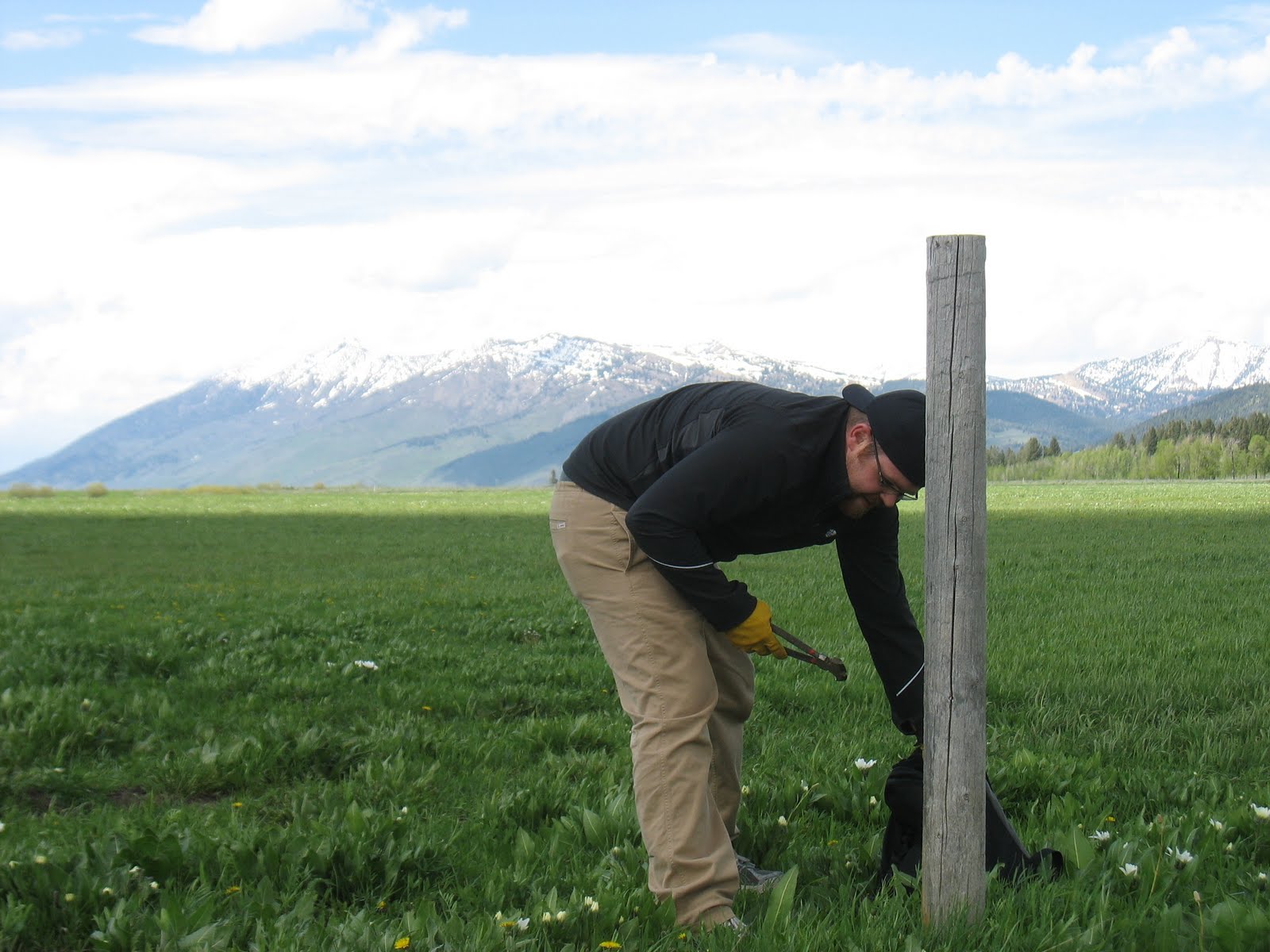
We collect data on the effects of grazing by maintaining exclosure cages in each pasture. These chicken wire and t-post structures are designed to preserve a small area of un-grazed grass for use as control data. At the end of the grazing season, we’ll measure the volume of grass in both the grazed and un-grazed areas to measure comparatively the overall impact of the grazing period. Chris Little, East Idaho Field Representative, will account for any instances of under or over-grazing as he designs next year’s grazing schedule for the Flat Ranch.

We’ve also installed several rain gauges throughout the property and are looking forward to utilizing such data to assess vegetative health in both the wettest and driest areas of the property.

Our operation as a working, sustainable cattle ranch speaks to the variety of elements that contribute to our goals here at the Flat Ranch, as we work to preserve not only the ecological assets of this area but the cultural and community assets as well. And as the summer months draw to a close, we at the Flat Ranch find our own boots a bit dustier, our denim with a few more creases—the cowboy bug is an undeniably fun one to catch.


Monday, September 19, 2011

South Fork Without a Fly Rod

Mention the South Fork of the Snake River to many outdoor enthusiasts, and the first thought is world-class fly fishing. And indeed, the South Fork offers legendary fishing for Yellowstone cutthroat trout, which often rise eagerly to dry flies.

Most of the South Fork's visitors--who come from all over the world--come to fish.

But the South Fork is a spectacular place even without a fly rod. And even for the most avid anglers, a trip here is not only about fish. It's about stunning scenery and abundant wildlife, too. Conservancy philanthropy staffers Justin Petty and Clark Shafer, avid fly anglers both, recently traveled the canyon without fly rods. Clark snapped these photos during the trip. (See below for directions to the hiking trail they used).

It's hard to believe this beautiful place was at one time slated for housing developments and even a golf course. The efforts of conservationists led to nearly the entire main canyon being protected from development. The Nature Conservancy, the Teton Regional Land Trust, Conservation Fund and Bureau of Land Management worked together to protect this special place through conservation easements.

The view you see today is the view future generations will enjoy.

With fly rod or without, visit the South Fork. It's a stunning testament to what your support of conservation accomplishes.


Directions: A great place to enjoy these views is on the trail accessed Dry Canyon Camp #2. After Pine Creek camp sites, look for the large sandstone cliffs on river left. Get to the river right and look for an island.

At the bottom of the island there is a slough that feeds the main river. Pull into the slough and row up river until you see a sign for Dry Canyon #3 camp site (DC2).

Park the boat here and walk up a short but steep trail to the designated camp site. You will see a trail that leads away from the river up Dry Canyon. This turns into a two-track and after 1/2 mile there is a junction.

At the junction, go left and up the hill. Walk for approximately one mile until you get to a view of the entire river corridor. This hike takes about one hour.

Friday, September 09, 2011

Ten Ways to Enjoy Silver Creek This Fall

Most people associate Silver Creek with the summer time. It's the time of tricos and rising trout, and Silver Creek makes the perfect stop for a weekend getaway or a stop on a cross-country road trip.

But fall is one of the most beautiful times on the preserve. With the days getting cooler and the wildlife getting active, there's a lot happening. Looking for an excuse to visit? Here are ten things to check out over the next two months:

1. Capture the colors. Silver Creek is known for the beautiful morning and evening light. The shifting colors are even more profound in the fall. It's often a kaleidoscope, with yellow aspens, red sunsets, purple hills. It's the perfect spot for photographers--and painters. But sometimes it's nice just to sit and try to take it all in.

2. Volunteer. Thousands of native shrubs will be planted along tributary streams and adjacent private property this fall. This ambitious effort will shade the streams, providing cooler water, less sediment, and better habitat for trout and birds. Want to give back a little to the creek you love? Phone 208-788-7910 to sign up.

3. Spot a moose on the loose. Many first-time visitors remark with some disbelief, "Moose? Here?" At first glance, the high desert around Silver Creek doesn't look like moose country. But the preserve has become one of the best places to see these animals in southern Idaho. Look for them in meadows and in the willows at dusk and dawn. Just give them plenty of space: A moose can run very fast and have a foul temper. Enjoy them, but at a distance!

4. Watch the small stuff. Sure, everyone wants to see a moose. But the conservation efforts at Silver Creek have paid off for a whole host of smaller critters, too. Recently, staff have been noticing a number of kids out with nets on the preserve. Follow their lead. Bushy-tailed wood rats, fence lizards, butterflies, beetles, least chipmunks, warblers and more all await your discovery. Look closely, and you'll be amazed at what you see.
5. Listen to the buglers. It's one of the wildest sounds in nature: the fall bugling of rutting bull elk. And already, it's echoing around the preserve, from the Picabo Hills and in the fields. When several bulls get going, it's guaranteed to send a chill up your spine.

6. Look up. It's a bit smoky at the moment, but later in the fall, the night skies are astounding. You'll be watching the Milky accompanied not only by the bugle corps (see above), but also howling coyotes, hooting owls and a host of other sounds. 7. Catch the evening flight. Flocks of sandhill cranes, ducks and geese circle overhead, pitching into wetlands for food and rest. They create their own chorus of whistling wings and haunting calls. You can often pick out some more unusual species, like canvasbacks and ring-necked ducks. For many of these birds, this is one stop on a very long fall journey. Wish them well along their way.
8. Of course: Go fishing. The tricos have faded away and the brown drakes are a distant memory. So are most of the anglers. Now is the time to have the creek to yourself. The fishing can be much better than you think. Try terrestrials like beetles, ants or damselflies in the afternoon. Look for some of the excellent hatches of baetis or pale morning duns. And if you're not afraid of the dark, try a mouse pattern at night to attract one of those legendary brown trout.
9. Write down your thoughts. For centuries, naturalists have kept field journals, providing important records ranging from bird sightings to climate. That tradition continues with many of today's visitors continuing to log what they see. Have an experience you'd love to share? Email us and we'd love to run it on Idaho Nature Notes in the coming weeks!

10. Follow your fancy. Hike. Canoe. Bird. Photograph. Relax. We're saving a place for you. Get out and enjoy it. The preserve is open 7 days a week, 365 days a year. We only ask that you respect nature and other people, that you sign in at the visitor center, and if you enjoy the experience, consider a gift to The Nature Conservancy, to ensure we can continue providing these experiences.

Photos: Sunset (Giuseppe Saitta), canoeist by moose (Laura Hubbard), elk (Matt Miller), ducks (TNC archive), angler with trout (Kirk Keogh, first2lastlight.com), boardwalk (Kirk Keogh, first2lastlight.com).

Tuesday, September 06, 2011

Silver Creek 35th Anniversary Poster Winner

The votes have been counted, and here's the image selected for Silver Creek's 35th anniversary poster, taken by Laura Speck.

The poster is currently being designed and will be available this fall.

Thanks to all contest participants--we had many incredible Silver Creek images submitted--and to everyone who voted in the contest.

Tomorrow: Ten ways to enjoy Silver Creek this fall.

Wednesday, August 24, 2011

Smoky Waters Day Camp visits the Flat Ranch

Text and images by volunteer Flat Ranch summer host, Nancy Elkins

On Wednesday, August 3rd, the Flat Ranch came alive with the laughter, squeals and high energy of 24 children from the Smokey Waters Day Camp, offered by the town of West Yellowstone's summer recreation program. The program meets daily Monday through Friday, but Wednesdays are set aside for out-of-town field trips.

As the children streamed off the school bus and onto the porch of the Flat Ranch visitor center, they were asked why they were all wearing orange shirts. The children replied in unison, "So the counselors can find us!" Sounds like these counselors have a bit of experience with kids. Four counselors joined the group for this outing.

Before starting off on their nature adventure, the children gathered on the porch and did stretches. Arms, legs, backs and torsos stretched and twisted to get ready for the hike. The lead counselor then had a question and answer session to see how many of the kids knew about the importance of conserving nature. First question to clarify was, "What is conservation?"

Everyone came prepared with bottled water and a lunch to eat at the end of the hike. As they marched across the yard and out the gate, the counselors started pointing out the different wildflowers—looked like they were already learning something. The group hiked to the Henry's Fork Outlet, which flows through the Flat Ranch, and had fun learning about local birds and wildlife. After the hike, they returned to the Visitor Center to enjoy their picnic lunches on the porch.

The Nature Conservancy encourages school groups to visit the Flat Ranch. Although there is no structured program, there is a "hands on" display in the Visitor Center where children can touch and feel animal skins, bones and antlers. The grounds are always open for hiking, birding, fishing, picnics and wildlife viewing. No reservations are necessary, but advance notice is appreciated. The visitor center is open Tuesday through Sunday (closed Mondays) until early October. For more information, call the Flat Ranch Visitor Center at (208) 558-7629.


Sunday, August 21, 2011

Wolverine Sighting in Pioneer Mountains

Story and photo by Jeff Barney, biological field technician, Heart Rock Ranch

Last weekend I was backpacking and fishing in the Pioneers. From Copper Basin I hiked up Broad Canyon to Goat and Baptie Lakes in hopes of catching cutthroat, golden trout and grayling.

Saturday night just before dusk I noticed a large mammal across Goat Lake where I was camped. At first I thought it was an otter when it popped out of the water, but as it loped along the shore I grabbed my monocular and there was no mistaking it as a wolverine—my first sighting ever! I watched it for 15 minutes as it did a semi-circle around the 150 acre lake. It came closer, to 120 yards looked at me and kept going.

It ran effortlessly up a rocky moraine and disappeared. I ran uphill to get a closer look and couldn't find it. Walking back to camp I spotted it hunting along the north shoreline. It saw me and headed up the steepest slope and over the top toward Betty Lake. Man that critter could climb and without a sound on the loose rock.

Sunday morning he was back again about 9:00 across the lake! I watched him for 10 minutes as it summer-saulted twice down the snowy bank and then rolling on his back in the snow; reminded me of a dog playing. Very cool to watch! Afterward he again glided uphill with ease toward Standhope Peak and disappeared.

I got a few lousy photos as my camera batteries were dying. I had been taking snaps of the cutthroats I caught and the scenery that day so you'll have to forgive the distant shots of the critter. You might have to zoom in to see him.


Anyway, my biologist training kicked in, and I scurried over to where I saw him playing in the snow. Surely he left a few hairs in his tumbles down the snow fields. I was able to get one battery to hold a charge long enough to photograph a few tracks in the snow. With my Ziploc bag, I surveyed the snow for any hair, blood, scat I could find. I must have looked for 20 minutes in that one snow patch-- not a stinking follicle.

Understand that Idaho biologists use winter hair traps to snag a sample strands from a baited area. From the hairs they can work up the DNA fingerprint of that individual and identify it if they have previous hair samples from him. They keep records of each critter's home range and when/where he's been. Across all of Idaho, Wyoming and Montana they estimate 28-52 wolverines so to see one is really rare!

I wanted to relate this story given the Conservancy's work across the Pioneer Range. This area is near-and-dear to me. I think the opportunities to preserve and protect these vast expanses of wildlands are critical for rare species like wolverine.

Thanks for letting share my little adventure.

P/S: Have you voted for your favorite image to grace the Silver Creek Preserve 35th Anniversary poster yet? Voting ends this week!

Thursday, August 18, 2011

Community Film Screening in east Idaho

Join us this weekend for a free film screening of National Geographic's "Moose: Titans of the North." See you there!


Thursday, August 11, 2011

Curlew Update


Text by Flat Ranch Manager Sarah Grigg and Volunteer Host Nancy Elkins

The Nature Conservancy’s Flat Ranch’s Ranch Preserve provide a key breeding ground for the rare and imperiled long-billed curlew, the largest North American shorebird.

In an effort to better understand the specific habitat features required by this species, Idaho Department of Fish & Game biologists visit the property several times throughout the summer to monitor curlew population numbers.

An initial survey in June turned up 100 individual birds, most of which were displaying breeding behavior. “This is the largest concentration of long-billed curlew that we know of in the Upper Snake Region and is a very significant population for Idaho," noted IDFG Regional Biologist Rob Cavallaro.

About 40 curlews were spotted during the second survey on July 11. These lower numbers do not necessarily reflect a loss of birds, but rather indicate changes in behavior.

Once curlews have laid their eggs, the female sits on the nest, remaining low and flush to the ground to avoid predation.

When broods hatch, the birds move to cover, sticking to tall grasses, and shrubs. We noticed during our July survey that many of the birds were located in tall Wyethia (mule's ear).

On occasion, birds with broods will mob a perceived threat, and dive bomb the trespasser. Though we did not experience this mobbing behavior, we did witness one perturbed curlew fearlessly chase two adult bald eagles.

Thanks to Rob Cavallaro and his crew for leading the charge on these intensive surveys, and for teaching Flat Ranch staff so much about this rare and imperiled species.

Friday, August 05, 2011

Ditch Fishing & Bison Dung Greeting Cards: A Flat Ranch Collage


Text by Flat Ranch Manager Sarah Grigg and Volunteer Host Nancy Elkins

Photos by Sarah Grigg and Chris Little

Where to begin? July has flown by and so much has taken place in so few weeks. Here is the latest news from The Nature Conservancy's Flat Ranch Preserve.

Electrofishing Irrigation Ditches

The Flat Ranch Preserve and neighboring private and state lands keep cows watered through the use of irrigation ditches that divert water from the Henry's Lake Outlet. Fish from the outlet sometimes swim into these shallow, exposed artificial channels, which may lead to fish kills when temperatures rise in late summer.

The Nature Conservancy strives to employ ranching practices that are compatible with healthy fisheries, such as erecting electric fence around streams and creeks to keep cattle from eroding banks.

In an effort to better understand the impact of these ditches on the outlet, the Flat Ranch and several local fisheries groups, including the Henry’s Fork Foundation and Idaho Department of Fish and Game, collaborated to electrofish these artificial waterways to take inventory of what is or is not living in our ditches.

An initial sweep through the West and East ditches on July 13 (when flows from the dam were exceptionally high) revealed Utah chubs, Utah suckers, and minnows (redside shiners).

While trout were not discovered during this effort, the species identified are important as forage for larger fish (such as trout), according to Henry's Lake manager Jessica Buelow. A second session on July 20 produced a single brook trout in the West ditch and similar forage species in the East.

With this data, the Flat Ranch, natural resources agencies, and other nonprofits will be better able to determine if steps need to be taken to install fish screens or fish returns on the ditches. More data will be collected in August and September to generate a broader picture of what species are using the ditches during various flows and at different times of year. Nature Art Expo a Smash Hit

The porch of The Nature Conservancy Flat Ranch turned into an outdoor "gallery" of nature art on Friday, July 22 and Saturday, July 23.

Twelve regional artists displayed their talents, ranging from willow furniture, glass fish and watercolors to inlaid wood work and even greeting cards made from bison dung!

Adding to the festive atmosphere was lovely harp music, played by 12-year-old Sarah Close of Rigby.

Visitors to the show were also treated to gourmet refreshments such as palmiers, cookies, and homemade cherry lemonade, provided by The Henry's Fork Lodge (Island Park), Reel Food on the Fly (Cameron, MT) and the Tawny Moose (Ashton).

With the warm summer weather, wildflowers in bloom throughout the yard, the harp music drifting through the air and the chatter of artists and visitors, it was the perfect venue for an art show with a nature theme.

Check back for more Flat Ranch updates on this blog, including the latest on the curlew counts and the installation of a canoe gate.

Monday, August 01, 2011

Vote for the Silver Creek 35th Anniversary Poster!

Special posters have become a popular tradition for special Silver Creek anniversaries and events. Many Silver Creek fans have complete collections.

This year, you get to decide the winning poster image. Below are the seven finalists chosen by our Silver Creek staff. One of these seven images will be selected for use in the Silver Creek 35th anniversary poster. You can click on each image to see a larger version of it.

To vote: email Dayna Gross with the subject line "Poster Contest" and include in the email body the number and name of your poster. Enjoy the photos, and email your vote!

1. Flowers by the creek, Laura Speck


2. Preserve autumn, Jane Mottern
3. Immature eagle, Ci Scola

4. Cloudy preserve, Nick Price

5. Thunderstorm, Nick Price

6. Winter swans, Ci Scola

7. Sandhill cranes, Joe Bobber

Monday, July 25, 2011

Beat the Heat

With much of southern Idaho in the grips of our usual heat wave, many of us find ways to cope: We head to the mountains, or turn up the air conditioning. We go to the water to swim or float. We try to spend our time outdoors in the late evening or early morning, when it's coolest.

Wild animals, of course, behave in similar ways to "beat the heat." Summer can be a taxing time for many critters.

Just it takes precious calories to stay warm in the winter, it can take calories to stay cool in the summer. Wildlife accomplish this in familiar ways: They seek shade during the heat of the day. They move into the high mountains. They take refuge on (or in) creeks and winters.

Or they go underground.

Many species of ground squirrels in southern Idaho disappear at this time of year. Think about it: Ground squirrels are highly visible in the spring in nearly every patch of sagebrush, farm field and meadow.

And then, they disappear. Poof.

The heat takes too much energy for the squirrels to survive. And so, for some species, they exist in a torpor underground. Their metabolism is lower and they exist in a "deep sleep" for periods of time. For some, they remain underground for eight months of the year.

For instance, take the Columbia ground squirrels so common around Silver Creek. They emerge in mid- to late-April. And then, in early July, they return to their burrows for a very long dormancy. Sometimes they reemerge for a short period in the autumn. Other times they don't re-emerge until April.

It boggles our human notions of time to imagine a species that is dormant for 8 or more months each year of its life.

Yellow-bellied marmots in the cool Idaho Rockies will remain active through the fall. In southern Idaho, many go into dormancy beginning in July.

Ground squirrels of higher elevation mountains--like the Uinta and golden-mantled ground squirrels of Yellowstone National Park--will stay active all summer and won't hibernate until fall.

And so, if you're feeling a bit lethargic in the heat, you can still feel productive compared to ground squirrels: They won't reemerge from their dens until next April!

Wednesday, July 20, 2011

Silver Creek Fishing Report - July 20, 2011


Silver Creek fishing has been tough, but it is improving as warm weather and increased hatches have made for happier fishermen.

Pale morning duns (PMDs) and baetis are still at the top of the menu, which are best fished in the morning or evenings. The trico hatch is on the tip of everyone’s tongues as more are being spotted, but the best of the hatch is still likely a few days away.

Damselflies are out in droves, and their large size makes them a fun option for those of us who like a large fly. Also, don’t forget to bring along a few caddis patterns. Small hoppers, flying ants, and beetles should also be in your fly box, especially during the heat of the day.

If you are looking for a break from the heat, the full moon has had fish feeding through the night, and a mouse pattern is always fun.

Many reports indicate that the fish haven’t been surfacing during the day so dry flies have been ignored, but don’t give up! I have seen great success in recent weeks using minnow streamers and nymphs.

That’s the latest at Silver Creek Preserve. May the inside of your waders stay dry, your fly land true, and happy fishing.

Matthew Hough, Silver Creek Preserve assistant manager

Tuesday, July 19, 2011

Free Leopold Film in Boise, 7/20

Greenfire: The Life and Legacy of Aldo Leopold
Free showing
7 p.m. July 20, 2011
The Flicks, Boise

Tomorrow evening, attend a free showing of Greenfire: The Life and Legacy of Aldo Leopold. It's the first feature-length film on visionary conservationist and author Aldo Leopold (1887-1948).

Watch the trailer.

Leopold is best known as author of a collection of essays, A Sand County Almanac. His words and ideas remain as relevant today as they were when first published soon after his death. Arguably, no one has ever said it better, before or since.

Leopold remains one of the most quotable authors on the land ethic, an idea he coined. Many of his ideas seem notably ahead of his time: He predicted the spread of cheatgrass around the West. He realized the important role large predators play in ecosystems. He recognized people as an integral part of conservation.

Leopold thought deeply about conservation issues, discussed them, read about them and wrote about them. But behind his words was a deep love of the outdoors, of wild things and wild places. His conservation ethic was informed by time on the ground, by hunting and fishing and watching and exploring. Without the personal observation, his words lack context. It's a lesson all conservationists should heed. Being out there still matters.

More importantly, Leopold considered his opinions, and changed them, as so eloquently described in Julianne Lutz Newton's Aldo Leopold's Odyssey. On many issues, Leopold's experience and scholarship led him to strikingly different conclusions than he had espoused earlier in life.

Rather than shrinking in fear of being a "flip flopper," he evolved as a thinker and a conservationist, culminating in A Sand County Almanac. In a time of increasingly strident public debate, of lines in the sand, of name calling and meaningless message points, Leopold continues to remind us that we can only really move forward if , as one of my mentors put it, "we listen at the risk of being changed."

We hope you can join us at the film tomorrow night, co-sponsored by The Nature Conservancy, and learn more about Leopold and his remarkable legacy.

Monday, July 18, 2011

Flat Ranch: Upcoming Events


The Nature Conservancy of Idaho presents:
The 2011 Summer Speaker Series at the Flat Ranch

Wednesday, July 20
Wolverines of the Greater Yellowstone, 7:00 p.m. – 8:00 p.m.

Wolverine expert Bob Inman of the Wildlife Conservation Society recently conducted a camera trap study on the rarest carnivore in North America. While most of us won't see a wolverine firsthand, you'll have the opportunity to view images of local wolverines and learn more about the challenges to studying and conserving these scrappy carnivores.

Friday, July 22 – Saturday, July 23
Nature Art Expo, 10:00 a.m. – 5:00 p.m.

The Nature Conservancy and the Idaho Art Lab present the 2011 Nature Art Expo. Stop by the Flat Ranch during Pioneer Days Antiques Weekend and browse the works of local artists on the porch of the Visitor Center. Artists from southeast Idaho will display and sell original artwork with nature themes for two full days at the Flat Ranch. Light refreshments provided by local businesses.

Saturday, July 23
Geological & Pioneer History of Southeast Idaho, 7:00 p.m. – 8:00 p.m.

BYU-Idaho history expert Professor Larry Coates will provide an overview of the geological history of southeast Idaho and how unique landscape features impacted pioneer settlement of the region.

Wednesday, July 27
Working Dogs for Conservation, 7:00 p.m. – 8:00 p.m.

Come meet the dogs who are doing their part to study rare and endangered species in some of the wildest habitat on the planet, from Hawaii to China to Montana. Trainer Meghan Parks will describe the research with which these dogs assist, as well as conduct a live scent detection demonstration. Great for adults and kids, alike!

Saturday, July 30
Landscape Photography with High Dynamic Range, 7:00 p.m. – 8:00 p.m.

Can't get the sun and the shadows into the same shot? Photos of landscapes seem more dull than when you were there? In this talk and demonstration, Dave Katsuki will show you how to use your DSLR to create more dramatic landscapes using HDR technology and software. HDR is a technique that many serious photographers are using to enhance their images. It combines multiple shots at differing exposures into a single image that can be as realistic or surreal as desired.

Saturday, August 6
Raptors of Yellowstone, 7:00 p.m. – 8:00 p.m.

Come to the Flat Ranch to meet our resident hawks, owls, falcons and eagles. The Grizzly and Wolf Discovery Center will bring live raptors for a talk on diurnal and nocturnal birds of prey of the Greater Yellowstone Ecosystem. Great for adults and kids, alike!

Friday, July 15, 2011

Farm & Biodiversity Tour

By Dayna Gross, Silver Creek Preserve manager

On June 23, Oregon State University held a farms and biodiversity tour in southcentral Idaho, including visits to Ernie’s Organic Farm near Shoshone and the showcase barley farm on the Stevenson property in the Silver Creek valley.

The stated purpose of the tour was to “see first-hand the progressive biodiversity enhancement practices that are driving sustainable agriculture forward in the 21st century and to interact directly with scientists, farmers and professionals who are helping us understand the role and importance of on-farm biodiversity for crop quality, yield and pesticide use reduction.”

We talked about a variety of farming practices and how they affect local biodiversity. Subjects included: integrated pest management, no till farming, cover crops, wetland protection, conservation easements, wildlife, restoration, native plants, beneficial insects and pollinators, soil, organic farming, water conservation, incentive programs for farmers, and the opportunities and constraints involved with all of the above.


We started the tour winding along the Little Wood River on Ernie’s Organics, a farm owned by Fred and Judy Bross, and then headed to the Stevenson property.

On both farms, the substantial riparian areas provide habitat for a variety of animals and the buffers along the agricultural fields are home to an abundance of beneficial insects and pollinators.

The biggest revelation of the day came to me as we looked for insects within the buffer zones on the Brossy property. Because of my background and experience, I have been thinking of landscapes primarily as wildlife corridors and water systems—but there are ecosystems within the landscape that are just as important.


What looks like unused transition ground around agricultural fields can be important habitat for insects, many of which contribute to healthier crops.

For instance, the beetles that I collect with my sons (photo above) as we go for walks thrive in the native habitat along the road and move into the farm ground at night where they eat pests.

If buffer zones of native and flowering plants are close enough to crops, they reduce the need for herbicides and increase the resilience of the crop.

Similarly, pollinators are important for sustaining all kinds of natural systems as well as many of the crops we grow. I often promote riparian buffer zones as great wildlife habitat and important features for water quality and quantity (which they are). But they have been simultaneously providing important habitat for all kinds of little critters that make farming more productive, healthy, and sustainable.

Amazing what you learn when you start looking really, really, closely!

For more information on insects and their role in healthy farms and healthy habitat, contact Gwendolyne Ellen or the Xerces Society.

Wednesday, July 13, 2011

Flat Ranch: The Cows Arrive


Story and photos by Dave Katsuki, additional photos by Sarah Grigg and Nancy Elkins

The Flat Ranch is a working cattle ranch, and working cattle ranches have fences--lots of them! Getting the ranch ready for its summer season means getting all those fences ready for the cattle that arrive in July.

In this part of the country, heavy winter snow dictates that most barbed wire and electric fences are “lay-down fences,” built to allow the wire and sometimes movable posts (called “dancers”) to lay down on the ground in the autumn so that they won’t get broken by the weight of the snow.

As the ranch wakes up in the spring, the cowboys, staff and volunteers check the fence lines, put the fences up and make any needed repairs (and there are always needed repairs).
Luckily the cowboys do most of the fencing, and they have done it for many years, but for the new staff and volunteers, there is often a learning curve: Learning to handle barbed wire and using the fence stretcher. Repairing lay-down gates. Grafting new wire onto tired old wire (have to stretch the dollars as well as the wire). Repairing and lighting up electric fences. Replacing rails in old jack fences.

But the hard work is all worth it if one can look out over the fields covered with wild flowers, surrounded by the mountains.

And then the cattle arrive! On July 6, six trucks from Spring Eagle Ranch arrived and unloaded 240 cattle into the corral.

Cowboys sorted the cattle and branded a dozen calves to get ready to drive the herd out to their first pasture. The cowboys were really talented, and their horses seemed telepathic, as the cowboys cut the cows out and roped the calves for branding and vaccinating. It feels like a private rodeo!

The next day, the cowboys drove the cattle to their first pasture, where they will remain for a week. The cattle look pretty happy after a winter down in the desert!

One of the missions of the Flat Ranch is to show that cattle ranching is compatible with conservation.

The cattle graze in 12 different pastures, with an intensive grazing rotation that moves from pasture to pasture on a 2 to 10 day schedule. This prevents over-grazing and mimics the feeding patterns of bison on the grasslands.
A Big Thanks to All Our Volunteers
Dr. Nick Markin and Dr.-to-be Kara Markin, of Omaha, Nebraska stopped by the Flat Ranch for a visit and were recruited as fencing volunteers (see photos above). With the arrival of cattle, electric fencing is erected around creeks to protect banks and streams. The Markins were essential in stringing the fence in time for the arrival of the cattle.

Our volunteers support the ranch in many ways other than fence repair.

Idaho Fish & Game Master Naturalist volunteers have also been tremendously helpful. Penny Freppon acted as visitor center docent for an afternoon, allowing Flat Ranch staff to conduct work in the field. Nancy Olson, Phyllis King, and Lee King undertook a major trash pick-up along the pastures lining Highway 20, hauling off an entire truck-load of debris. Many thanks to all our volunteers who give their time to keep the ranch running!

Wednesday, July 06, 2011

Fishing, Flowers and Fun on the Flats

Blog and photos by Nature Conservancy volunteers Nancy Elkins and Dave Katsuki.

Fly fishers have discovered that Henry’s Outlet on the Flat Ranch is one of the best fishing spots at this time of the year. With the rapid snow run-off muddying the surrounding lakes and streams, the outlet is providing clear and easy moving waters for excellent fishing.

Local fishing guides are bringing clients to the Flat Ranch to fish the outlet, and the results speak for themselves. Here are just a few comments written in the Flat Ranch guest book about the fishing, as well as the experience:

“Lovely, gorgeous, beautiful””
“Absolutely spectacular! Fish, flowers and sand hill cranes. Terrific investment!!!”
“12-inch rainbow, incredible place!”
“Two beautiful cutthroat. Marvelous, wonderful walk”
“19.5 inch cutt. Thanks!”
“4 cutts on lead-free conehead bugger on a 40+ year old UL spin rod”


And that’s just a small sample of the great comments in our guest book.

One thing that is making the ranch so lovely and beautiful are the fields of wildflowers. Carpets of mule’s ear, larkspur and camas frame the setting of the snowcapped mountains. Peeking their heads out from the fields are also sticky geranium, prairie smoke and mouse-ear chickweed. Many visitors have stopped by just to walk in the fields and take photographs.

The 2011 summer speaker series started with a roar on June 15th with a standing-room only talk about cougars by Marilyn Cuthill of Craighead Beringia South. The fun continued the following week with fantastic photos of fly fishing in international locations like Kashmir, Cuba and the Amazon, presented by Jim Klug of Yellowdog Flyfishing Adventures.

If you’ve ever been nervous about how to use your bear spray, the folks at the “bear aware” lecture, led by Leisja Meates of IDFG/USFS, had some hands-on time with water-based practice bear spray. It was quite a sight with everyone lined up in the yard, shooting off their bear spray.


The speaker series runs throughout the summer on most Wednesdays and Saturdays. More fun will take place on Friday July 22nd and Saturday, July 23rd when the Flat Ranch will host a Nature Art Expo in conjunction with the Idaho Art Lab. Local artists will feature their nature-related art for sale.

As you can see, lots of things are happening at the Flat Ranch in Island Park. Whether you are into fishing, flowers, fun, hiking, birding or relaxing, you can experience it all at the ranch.


Tuesday, July 05, 2011

Silver Creek Fishing Report - July 5, 2011


Silver Creek intern Matt Hough submits the latest fishing report from Silver Creek. It sounds like things are finally picking up...

The latest reports at Silver Creek show warming and stabilizing weather to finally be improving fishing conditions on the preserve. As many of you know, our cool, wet weather has made fishing difficult and hatches late since season’s open.

Currently, pale morning duns (PMDs) and baetis are increasing in numbers, and reports indicate that they are about the only flies being used consistently on the preserve in a season marked by very inconsistent hatches.

For those of you that are (like me) and have trouble actually seeing a baetis fly in the water, try fishing them behind a PMD and (maybe) double your odds.

Fishing small, wet flies such as damsel nymphs and midges are also said to work when dry flies are ignored. Anglers have also mentioned sightings of a few green drakes, caddisflies, and stoneflies.

Unfortunately, the brown drakes are completely finished, but it was fun while it lasted. As always, the odds of success are increased with longer leaders (up to 12 feet) and finer tippet (6X to 7X).

Also, don’t underestimate the draw of terrestrials. Flying black ants and black beetles, along with a few bees, are said to have some success, especially during the midday lull.

I also spotted a couple of grasshoppers near the stream last weekend so hoppers may already be on the menu.

Nighttime fishing is thought to improve as the changing moon phases brighten the night. Night fishing is best enjoyed by fishing a mouse pattern near the edges to coax the behemoths out of their hiding spots.

That’s the latest at Silver Creek Preserve. For more specific fly patterns, consult with some of the knowledgeable staff of our local fly shops. Good luck to you and happy angling.

Matt Hough, July 5th, 2011

Friday, July 01, 2011

Best of all he loved the fall

Best of all he loved the fall
The leaves yellow on the cottonwoods
Leaves floating on the trout streams
And above the hills
The high blue windless skies
Now he will be a part of them forever.

Ernest Hemingway
July 21, 1899 - July 2, 1961