To provide the best experience possible, we are pleased to announce our blog has moved to nature.org/idahoblog. Follow us there for the latest on natural history, wildlife, and conservation stories from our staff and guest bloggers.
Thursday, September 17, 2015


Monday, August 17, 2015
As Fires Burn Up the Forest Service Budget, the Conservancy Calls for a Better Way to Fund Fire Suppression
by Will Whelan, director of government relations
As I write this post, Soda Fire in southwest Idaho is by far the largest wildfire in the nation, and Idahoans from Owyhee County to the Clearwater Valley are being advised to evacuate homes in the path of advancing flames. More than 60 large fires are active across the country, with nearly 20,000 firefighters on the lines. The entire national system for fire suppression is stretched. The toll on people, communities, and sagebrush habitats that we’ve worked so hard to protect has been heartbreaking.
The headlines grab our attention, but the impact of longer and more severe fire seasons extends far beyond the fire lines. A Forest Service report issued this month delivered a stark message: the skyrocketing cost of firefighting threatens the agency’s ability to manage for recreation, wildlife, restoration, jobs, and all of the other benefits that Americans derive from our public lands.
Twenty years ago, the Forest Service spent 16% of its budget on fire suppression. Today, that figure has increased to more than half. In ten years, two-thirds of the agency’s funds will go to fighting fires. Because the agency’s overall budget allocation has been basically flat for years, essential land conservation and stewardship programs have absorbed the blow as more and more money goes to suppression. I was stunned to discover that the Forest Service’s non-fire staff has fallen by 39% since 1998.

This is not a sustainable model for our public lands. Tens of millions of acres of national forest lands need restoration through actions such as stream rehabilitation, forest thinning, and prescribed fire. Three-quarters of forest trails don’t meet agency standards. The Forest Service’s road and facility maintenance backlog runs into the billions of dollars. None of these needs can be met if current trends are allowed to continue.
This week, I joined Senator Crapo (R-ID), Senator Risch (R-ID), and Senator Wyden (D-OR) at a press conference to promote the Wildfire Disaster Funding Act. This bi-partisan bill would change how the federal government budgets for wildfire disasters by making it similar to the way other disasters are funded. The public land agencies would continue to pay for fighting most fires. But, the costs associated with the disaster fires would be funded with disaster funds. The bill would have no impact on the overall federal budget or the deficit, according to the Congressional Budget Office. But it would finally give some breathing room for programs that support restoration, conservation, recreation, and the other public land values we prize.
A united Idaho congressional delegation is leading the fight for the bill. Congressman Mike Simpson is the lead co-sponsor in the House, and Senator Mike Crapo is the lead co-sponsor in the Senate. They are all working hard for this cause and have earned our thanks.
Editor’s note: A total of 283,686 acres have burned to date since the Soda Fire ignited on August 10. As of August 17, the fire is 70% contained. Resources deployed include 811 personnel, 6 helicopters, 36 engines, 14 crews, 13 water tenders, and 9 dozers.
To keep track of this and other fires around Idaho visit: http://idahofireinfo.blogspot.com/
As I write this post, Soda Fire in southwest Idaho is by far the largest wildfire in the nation, and Idahoans from Owyhee County to the Clearwater Valley are being advised to evacuate homes in the path of advancing flames. More than 60 large fires are active across the country, with nearly 20,000 firefighters on the lines. The entire national system for fire suppression is stretched. The toll on people, communities, and sagebrush habitats that we’ve worked so hard to protect has been heartbreaking.
 |
| Soda Fire Column © InciWeb |
The headlines grab our attention, but the impact of longer and more severe fire seasons extends far beyond the fire lines. A Forest Service report issued this month delivered a stark message: the skyrocketing cost of firefighting threatens the agency’s ability to manage for recreation, wildlife, restoration, jobs, and all of the other benefits that Americans derive from our public lands.
Twenty years ago, the Forest Service spent 16% of its budget on fire suppression. Today, that figure has increased to more than half. In ten years, two-thirds of the agency’s funds will go to fighting fires. Because the agency’s overall budget allocation has been basically flat for years, essential land conservation and stewardship programs have absorbed the blow as more and more money goes to suppression. I was stunned to discover that the Forest Service’s non-fire staff has fallen by 39% since 1998.

This week, I joined Senator Crapo (R-ID), Senator Risch (R-ID), and Senator Wyden (D-OR) at a press conference to promote the Wildfire Disaster Funding Act. This bi-partisan bill would change how the federal government budgets for wildfire disasters by making it similar to the way other disasters are funded. The public land agencies would continue to pay for fighting most fires. But, the costs associated with the disaster fires would be funded with disaster funds. The bill would have no impact on the overall federal budget or the deficit, according to the Congressional Budget Office. But it would finally give some breathing room for programs that support restoration, conservation, recreation, and the other public land values we prize.
 |
| Smokey Sign © S. Hellstrom |
A united Idaho congressional delegation is leading the fight for the bill. Congressman Mike Simpson is the lead co-sponsor in the House, and Senator Mike Crapo is the lead co-sponsor in the Senate. They are all working hard for this cause and have earned our thanks.
Editor’s note: A total of 283,686 acres have burned to date since the Soda Fire ignited on August 10. As of August 17, the fire is 70% contained. Resources deployed include 811 personnel, 6 helicopters, 36 engines, 14 crews, 13 water tenders, and 9 dozers.
To keep track of this and other fires around Idaho visit: http://idahofireinfo.blogspot.com/
Friday, August 14, 2015
Learning the Ropes
by Maria Rachal and Alex Jones, Flat Ranch Preserve summer interns
On June 5, we arrived for our first day of work as the
Flat Ranch’s summer interns. Earlier that week, through the generous support of
the A. Paul Knight Internship Program in Conservation through Washington and
Lee University, we had traveled over 2,000 miles from Virginia to Idaho. We go
to school in the valley of the Blue Ridge Mountains of the Appalachians,
another beautiful part of the country but a noticeable contrast to the Rocky
Mountains. Armed with a basic understanding of The Nature Conservancy’s mission
and an adventurous spirit for exploring the West, we both began our Flat Ranch
experiences not exactly sure what kinds of scientific or manual
responsibilities to expect.
 |
| Alex and Maria © Alex Jones |
Our
initial morning as Flat Ranch employees set the tone for the summer; our foremost
order of business was to purchase rubber boots for traversing the marshy areas
of the preserve and work gloves for just about everything else. When we
returned to the preserve, we sat down with Flat Ranch manager Matthew Ward to
review our work plan for the summer. The list of tasks seemed foreign and a
little overwhelming to two inexperienced ranch hands from the East Coast.
“Ensure
all fences are kept repaired.” For all the things that our college educations
prepared us for, building and fixing barbed wire or electric fences had somehow
never been covered. “Study preserve wildflowers.” Looking out on a sea of white, yellow, blue,
and purple blossoms, we really doubted we’d ever internalize most of the names
of the wildflowers found on our 1,600 acre property. “Study common invasive plant species found in Idaho.” If we could hardly keep track of the names of
the wildflowers on the preserve, how were we supposed to remember which
flowering plants weren’t actually supposed to be here?
 |
| Flat Ranch Fenceline © Megan Grover-Cereda |
After
receiving first-time lessons on how to drive a pick-up truck through the grass,
learning ATV 101, and having copies of Plants of the Rocky Mountains, Idaho’s Noxious Weeds, and Flat Ranch’s numbered cow pasture map tossed our way, we
were immediately trusted as full-fledged Flat Ranch employees. Despite our
initial lack of confidence in our aptitude for ranch work and wildlife and
plant assessments, Matthew quite willingly sent us off into the preserve to
learn. We quickly came to appreciate that often the best way to climb a steep
learning curve is to be thrown into the deep end. All of the skills we’ve
acquired this summer were completely new to us, from measuring stream flow and
cleaning out fish ladders, to monitoring grazing progress and even simply
managing to open the ever-challenging barbed wire gates between pastures. With
two months of work under our belts, we can say that our summer at Flat Ranch
has been a testament to the power of learning by doing.
Not
only have we noticed a distinct change in our ability to make significant
headway on projects at Flat Ranch, but we also realized that our time at Flat
Ranch has shifted and shaped our outlook on our environment outside of work.
For example, all of our time spent mending or raising fences has caused us to
occasionally admire the handiwork that went into a particular ranch’s fenceline
as we drive down the highway. Similarly, the time we have spent mapping
problematic weeds on the preserve has tuned us to exercise sharp eyes for
Canada thistle, houndstongue, oxeye daisy, common toadflax, and other invaders.
We knew we’d finally mastered these noxious weeds when we caught ourselves
pointing these species out to one another in various locations where we spent
our days off.
Furthermore, when we go on hikes in Yellowstone, we carry a wildflower identification book, not because we don’t know the names of any of the wildflowers, but because we’ve familiarized ourselves with so many at Flat Ranch and have developed a real curiosity for identifying species still unknown to us. As the days have turned into weeks and the weeks have turned into months, we’ve become so well-assimilated to our lifestyle as interns on the preserve that we’ve gained a keen interest in and fondness for our environs and subjects of work.
 |
| Flat Ranch Wildflowers © Chris Little |
Furthermore, when we go on hikes in Yellowstone, we carry a wildflower identification book, not because we don’t know the names of any of the wildflowers, but because we’ve familiarized ourselves with so many at Flat Ranch and have developed a real curiosity for identifying species still unknown to us. As the days have turned into weeks and the weeks have turned into months, we’ve become so well-assimilated to our lifestyle as interns on the preserve that we’ve gained a keen interest in and fondness for our environs and subjects of work.
Additionally,
as we’ve gotten to see more and more of Eastern Idaho and the surrounding areas
in Wyoming and Montana, we’ve come to understand how special our home at the
Flat Ranch is. While reading a Yellowstone trail guide book, we read of a
certain hike that stated, “and if you’re lucky, you might even be able to see a sandhill
crane!” We chuckled at this highlight, seeing as the Flat Ranch is home to a
plethora of sandhill cranes that we see practically each day we’re at work. To
experience the rich diversity of plants and wildlife this area has to offer, we
certainly don’t have to leave our workplace.
 |
| Sandhill Crane © Ken Miracle |
Along the way, even as we’ve grown to feel like
seasoned Flat Ranch interns, we’ve learned to expect the unexpected. We have
found ourselves in such adventurous situations as driving the ATV through a
hail storm, hiking many miles in hip waders, and nearly losing our rubber boots
in waist-deep muck.
Friday, July 31, 2015
California Condor
by Lisa Eller, director of communications
As we turned
another corner along the old coast Highway 1 between our campsite at Pfeiffer
Big Sur State Park and Sand Dollar Beach, I looked out admiringly at the
majestic scene, the Pacific Ocean crashing against the rugged coastline, framed
by the Los Padres National Forest. I could look at this view all day. This
stretch of road is one of my favorite drives and one of the most beautiful in
the West.
 |
| The rugged California Pacific coastline in the area near and north of Monterey, Carmel and Big Sur. Photo ©Lynn Mc Bride |
Looking
out at the fog rolling slowly by, my eyes began focusing on something unusual
coming out of the whiteness. Enormous black wings gliding above us, casting a
huge shadow below. I had never seen anything so big (and not manmade) in the
sky before, so it took me several seconds to realize that I was probably seeing
a California condor.
Growing
up in Southern California in the early 80s, I never thought I would see the
condor outside of captivity. The bird was a recurring topic of our natural
history lessons in school. By 1987 the California condor had become extinct in
the wild because of poaching, lead poisoning and habitat destruction. The 22
remaining wild and captive individuals were put into a captive breeding program
by the U.S. government in an effort to save the species.
Beginning
in 1991, condors were released back into the wild. But it wasn't until 2006
that a pair of released birds attempted to nest in a hollow tree near Big Sur.
According to Sky News, that was the first time in 100 years that a pair of condors
was seen nesting in Northern California. Click here for more information on the California condor.
My heart
began racing immediately after I spotted the rare bird — although I didn't
realize just how rare it was until doing some research later in our trip.
 |
| Portrait of a California condor (Gymnogyps californianus), the largest flying bird in North America and one of the most endangered birds in the world, shown here in flight, CA. © CA Fish and Game |
"That
was a California condor," I told my husband, who was driving the car. Ever
the skeptic, he insisted that what I had seen was probably a turkey vulture.
"No, I don't think it was. Pull up over here," I said, pointing ahead.
I wondered if we could catch another glimpse of the bird.
After he
turned into a scenic point and stopped the car, a condor (probably the same one
I had seen above) landed on the edge of the cliff in front of us. After getting
an impossibly close look at the bird's impressive size, characteristic bald, gray/nude-colored
head and the tag on its wing, we agreed that it was a condor. "Quick, take
a photo!" I told my shocked husband. But it was too late. The bird took
one look at us, stretched out its enormous, beautiful black wings and flew off
into the fog.
 |
| The author and her husband ©Lisa Eller |
Something
about seeing the bird made me sad and hopeful all at once. It was sad to think
how close we came to losing the species altogether, how small the population
remains and how seeing condors in captivity pales in comparison to seeing them
in the wild. Yet I couldn't shake the hopeful feeling that even when all seems
lost, swift conservation actions can be taken to reverse the course and move us
in the right direction. And to be clear, the condor is still critically
endangered and we still have a lot of work to do.
This
unforgettable experience made me think about birds that are meaningful to
Idahoans and integral to its landscapes, birds like the long-billed curlew and
Greater sage grouse. At varying levels, each of these species faces the same or
similar threats that the condor does. Habitat loss through various human uses
is a common thread. As an organization we could not possibly tackle all of
these threats at once. But I am thankful that we are focused on that key piece
of conserving, protecting and restoring habitat. And I'm thankful that we are
part of a community of organizations focused on doing its part to ensure we all
get a chance to see these majestic birds in the wild.
Friday, July 17, 2015
Cuba to Yellowstone
by Bob Unnasch director of science
During
the past several weeks I had the opportunity to take a break and travel some.
At the end of May I traveled to the Archipiélago de los Jardines de la Reina, a
cluster of islands off the southern coast of Cuba. Two weeks later I spent a
few days in Yellowstone.
While
honestly, the main reason for my visit to the Caribbean was to catch large fish
on flies, I was also excited to see the island’s biodiversity. Cuba is only 90
miles south of Florida and 140 miles east of the Yucatán. At times the Gulf of
Mexico Loop Current sweeps past the Yucatán peninsula and turns due east
brushing the northern coast of Cuba. Other times the current flows north through
the Gulf of Mexico then south along the western coast of Florida before flowing
east through the Straits of Florida. It seems like the ideal conveyor to carry
critters to the island. I anticipated the fauna of Cuba to be an amazing
collection of North and Central American critters.
 |
|
Going Fishing © Bob Unnasch
|
My
trip to the Jardines involved flying into Havana and then driving ~300 miles to
the small town of Júcaro. We then boarded a boat for a 60 mile trip to the
islands. To my great disappointment I saw no mammals, nor any evidence of
mammals. Similarly, I saw few bird species — even remarkably few individual
birds. I was dumbfounded; my daydreams of a biologically diverse paradise, shattered.
Maybe it was time to get my eyes checked.
Upon
my return, I did a bit of research and discovered that it wasn’t my eyes. Cuba's
native land mammals include two insectivores, one coney, and twelve rodents. Of
these, five are extinct, including the coney, and five are critically
endangered. By comparison, Yellowstone has 67 native mammals in the park,
(Idaho has 107).
 | |
|
Cuban hutia © Bob Unnasch
|
Our visit to Yellowstone National Park was a typical driving tour over a few days with a couple of stops at the Conservancy’s Flat Ranch. We saw all the charismatic mega-fauna that make Yellowstone famous and lots of small and medium mammals. It was fun, as always, to see the abundance and diversity of the park, and to imagine what the Rocky Mountains were like a millennium ago.
During
my drive home, I started to think about the contrast between Yellowstone and
Cuba. What would Yellowstone, or Idaho, be like if we only had a handful of
native mammals? It would certainly feel different... and empty. Conservation
biologists have described many tropical forest parks as suffering from an
“empty forest syndrome”. The forests still have their trees, but all the large
mammals are gone; typically the result of market hunting.
 |
|
Yellowstone bison © Alan W. Eckert
|
We
are seeing dramatic changes in the Rocky Mountains. Warmer winters have
released mountain pine beetles which are now decimating our forests. Our whitebark
pines, which play a keystone role in these ecosystems is disappearing. Whitebark
pine nuts are a crucial food resource for a diversity of animals, including the
Clark’s nutcracker and grizzly bears. We don’t know what will happen when those
pine nuts are no longer available. Climate change rather than market hunting
may well be emptying our forests. While we cannot predict how the future will
unfold, we can build on what we do know to hopefully minimize the impact of the
changes we see coming.
Ecologists
use the word niche as a catch-all term that means “all the biological,
ecological, and physical constraints on a species’ range”. Physical constraints
include climate, geology, soils, hydrology, etc. In 2010, two TNC
scientists, Mark Anderson and Charles Ferree proposed a unique strategy for
biodiversity conservation in light of climate change. Rather than focus on the
species, we should focus on maintaining those geophysical features that
ultimately control species distributions. This idea has taken hold and the
strategy is now called “Conserving Nature’s Stage”. Click here for more information.
 |
|
Flat Ranch bluebird © Marilynne Manguba
|
TNC
has embraced this idea and is now mapping the geophysical diversity (Nature’s
Stage) across North America. We completed this assessment for the Pacific
Northwest late last year, and are now identifying key areas for conservation.
The Doris Duke Charitable Foundation recently granted The Nature Conservancy $6,000,000
for land conservation work within these areas. I’m hopeful that by
conserving the diverse ecological stage we’ll be able to ensure that the actors
will always find a home.
Monday, July 06, 2015
Tree Hugger
by Valerie Connor board liaison/operations assistant
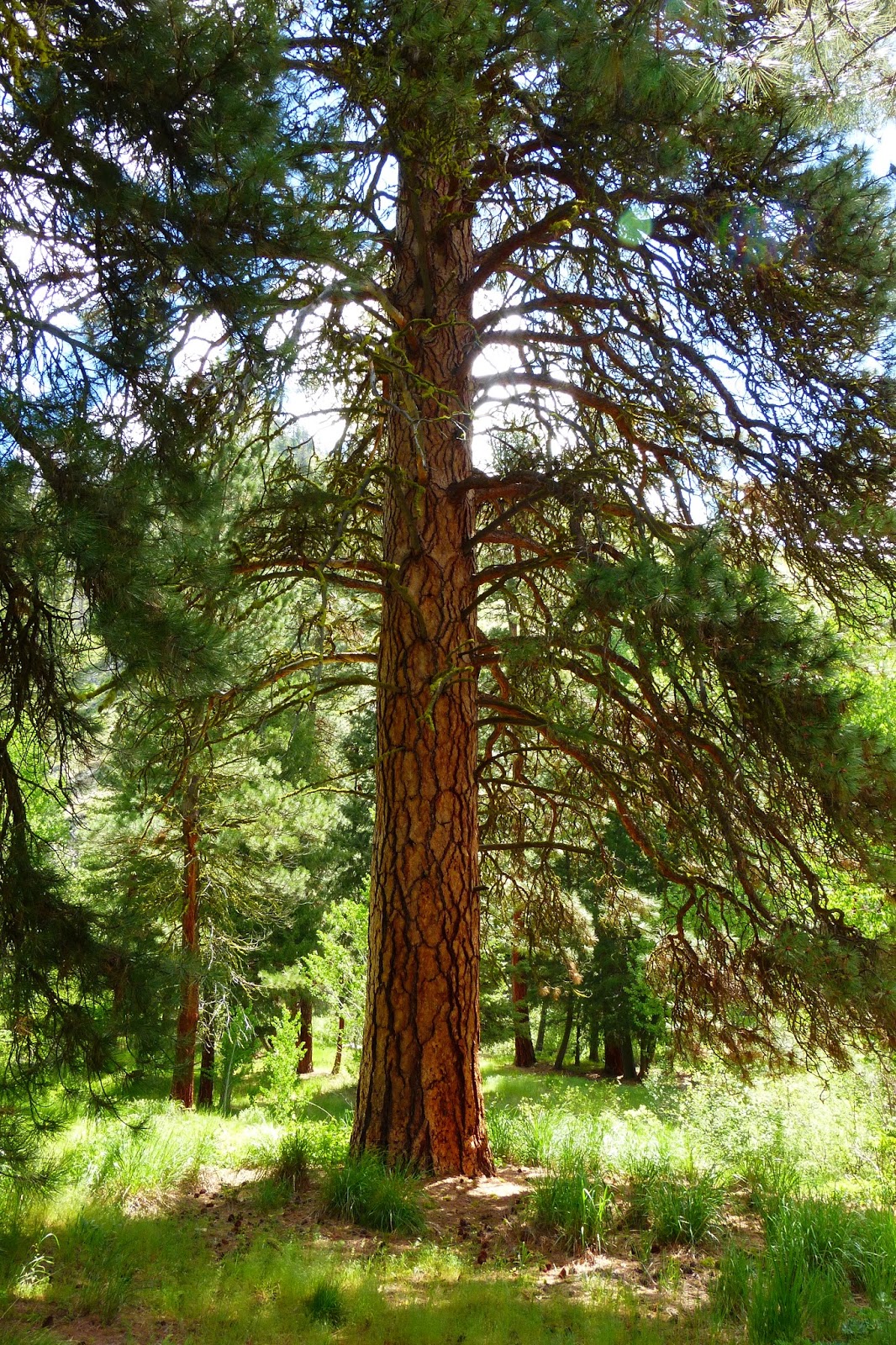
Big, strong, dark and handsome. I’m standing under a mighty Ponderosa Pine and it is my new favorite tree. The orange-brown color, the vanilla smell, and the puzzle-like texture of the bark are all so captivating. It’s the weekend and my husband and I are out exploring. We end up outside of Featherville in the Baumgartner campground. We set up camp beneath this pine, the canopy dense enough to create a circular open space at its base.
 |
|
Ponderosa Pine © Valerie Connor
|
Over the weekend, we get to know this tree and its
inhabitants. The first morning we watch western tanagers flying in and out of
its branches, flights of yellow and red flashing overhead, their fluty calls
making us smile- so cheerful and uplifting.
Later the nuthatches flew in and nimbly scurried around the trunk, excavating
for insects. Gray jays swooped in
looking for handouts.
 |
|
Western Tanager © Brian E. Small
|
Pinus ponderosa is a long-lived, common tree throughout
the western U.S. They are drought-tolerant trees with a thick protective bark
that can withstand low-intensity fire and have a deep tap root. Old growth
ponderosas can grow up to 180 feet tall and 4 feet in diameter. The cones are 3 to 6 inches long, and take two years to mature. The bark
starts off dark brown and turns to orange-yellow at about 90 years of age. Ponderosa
needles are bundled in threes and they are five to ten inches long.
Ponderosa Pine thrives from Canada to Mexico and
from the Pacific Coast eastward to South Dakota, an area that stretches over
more than 35 percent of the area of the United States. They make good lumber and were mercilessly
harvested over the course of a century of railroad building and development in
the West. Concurrently, fire suppression became the defacto forest management
policy. Over time, the buildup of flammable materials on the forest floor
resulted in hotter fires that the trees were not designed to withstand. The combination of these two factors quickly
diminished the forests across the Western US.
 |
|
Burned pine forest © Valerie Connor
|
The science of Forestry is well known, yet poor
management practices persist today. The
Nature Conservancy is taking a stand for forests, offering resources,
expertise, science and collaboration to help restore and protect our
forests. Find out more about our forest
initiatives here.
Back at the campground, we pack up. It rained
overnight and the trees look vibrant in the morning light. The tanagers fly in,
alight on a high branch and peer down at us.
We decide to stay just a few minutes longer and bask in the peaceful
shade of the ponderosa. I am drawn to this
illustrious tree and when I wrap my arms around its trunk, I feel one with
nature-just me, the ground and sky and my new favorite tree.
Subscribe to:
Posts (Atom)