Monday, June 30, 2014

Curlew Tracking Update from the Flat Ranch Preserve


by Jordan Reeves, East Idaho conservation manager
 
As you may recall from earlier blog posts, we’ve been anxiously awaiting the annual late spring arrival of long-billed curlew to our Flat Ranch Preserve. While we are always excited to witness the birds return to nest at the ranch, this year was particularly exciting because we have been planning for months to place a satellite transmitter on a curlew in order to track its annual migration.  
 
Curlew at the Ranch ©Megan Grover-Cereda/TNC


On May 28 we successfully fitted “AH,” a beautiful female curlew with a tracking device that will provide us with hourly GPS coordinates of her whereabouts throughout the year.  AH is the curlew’s temporary name while we await the results of a voting contest to choose her name. You can cast your vote here until July 11.

Fitting a curlew with a satellite transmitter is no small feat.  To capture AH, fit her with the transmitter and release her, we needed a team of scientists and volunteers. Skilled scientists from the Intermountain Bird Observatory and Idaho Department of Fish and Game used a mist net to very carefully capture AH while she was sitting on her nest. While they took her measurements and fitted her with her a solar-powered micro-transmitter, we watched over AH’s vacant nest to ensure no predators took advantage of her momentary absence to snatch her eggs.  After a transmitter was placed on AH and scientists were confident the lightweight device would not hinder her mobility, we released her and wished her the best for the long journey ahead. 

 Volunteers keeping watch ©Shyne Brothers

As AH flew away she left behind one of her feathers for Ellie, the youngest (and cutest!) volunteer. “This is the best day ever!” Ellie exclaimed. It was a poignant end to an exciting day. Ellie is the granddaughter of Debbie Empey, a local rancher who partnered with the Conservancy to ensure curlew and other species have the lands and waters they need to thrive.


Ellie with her feather ©Shyne Brothers

Now we sit back, cross our fingers for AH’s safety, and follow her movements over the next year as she travels to wintering grounds further south and (hopefully) returns to Idaho next summer for another nesting season.  We don’t know where East Idaho’s curlew travel during their annual migration so AH has many things to teach us!
To read more about our curlew project read an earlier blog we posted on this charismatic bird.  We also hope that AH is a pioneer in our Henry’s Fork curlew monitoring efforts.  To support us in tracking the migrations of more long-billed curlews, please donate here.

Monday, June 02, 2014

Night at the Museum – It’s Transforming

by Lou Lunte, deputy state director

Have you ever spent a night at a museum?  Tyrannosaurus roam the halls, mummies, ancient Romans, monkeys, and Neanderthals all wander in and out of exhibits. Well, not exactly, but a night at the Idaho State Museum of Natural History can be transforming in another way.  For the last five years my wife and I have volunteered to help chaperone 120+ 8-12 year-olds for a parent-less, adventure filled night at the Museum of Natural History in Pocatello.  Amazingly, this was the Museum’s 25th year of hosting this event for children, mostly from east Idaho, but also from Wyoming, Utah and even California.

Waiting at the front door of the Museum to greet families as parents dropped off their children for the night, I remembered back several years when my own daughters were able to be “pod” members, hanging out with other boys and girls amongst the dinosaurs and fossils.  My daughters had so much fun learning what happens when you drop gummy bears in dry ice, or mix Alka-Seltzer with soda or feel a snake crawl up your arm.  The museum is on the Idaho State University campus so the night starts with groups of the children going off with professors and graduate students to explore a suite of sciences, from nursing, to botany, to chemistry, to engineering and many more; all through hands-on and fun activities.

Photo Credit Lou Lunte

Coming towards me was a somewhat harried looking but smiling mom escorting her bright eyed daughter, sleeping bag and knapsack in hand.  “Are you ready for a fun night,” I asked the girl.  “Yes!” came the enthusiastic reply.  “Have you been to the museum before?” I asked.  “No, will I see dinosaurs?” she replied.  “Yes, and much more,” I responded, as the girl cheerfully headed through the door to start her night at the museum.

From a chaperone’s point of view, the night went amazingly well – only one sick child, one missing professor and a few moments in the wee hours to nap.  As we awoke the children from their slumber under the various museum exhibits and got them ready to return to their parents, I wondered what they thought about their night in the museum.  The little girl I greeted the day before was now leaving, pulling her mom by the hand and talking non-stop about what she’d done.  “Did you have fun?” I asked. “Yes, that was so cool!”  Turning to her mom she asked “Can I come back, please?  Look mom, there’s the goo I made!”  The mom was smiling and the two headed out, to show the “goo” to dad.

Photo Credit Lou Lunte

All the boys and girls leaving that day were sharing stories with families of their amazing night at the museum.  Reflecting on why I so enjoy volunteering for this event, it’s what I see and hear from the children as they leave in the morning.  Sure, it’s exciting to hang out in the museum with a bunch of other children and stay up past midnight eating pizza, but what I hear the children talking about as they leave, more than anything else, is the fun they had with science.  Yes, science!  They cheered on the physics graduate student as he shot smoke rings out of a 30 gallon barrel over their heads in the large auditorium.  They then frantically raised their hands to answer his questions about – why, and how.  This took place in every laboratory that night – the boys and girls had fun and shared their curiosity about how things work.

Photo credit Lou Lunte


As the last of the children and parents left the museum that morning, I had to smile as I wondered if all those parents knew what they were in for next.  For I knew from experience that beyond all the fun the children had that night, a transformation had also taken place for many of the children present – as the parents might soon find out!

Had I only known - my daughters went to the reptile session during their night at the museum! 

Thursday, May 15, 2014

Why We Count Birds At Silver Creek

Editor's note: This article originally appeared in a Friends of Silver Creek newsletter. It is republished here to mark the 10th anniversary of bird counts at Silver Creek Preserve. Read a Q&A about the author's birding experience over the past decade at nature.org/idaho.

By Poo Wright-Pulliam, master birder and long-time Conservancy volunteer

It’s dark outside and I wonder to myself, “Do I really have to get up this early?” I can hear the coffee brewing…thank goodness, as I stumble into the kitchen for a cup. I’m not a morning person. So how did I become so involved with the birds?

When I was asked to help get Silver Creek Preserve dedicated as an Important Bird Area (IBA) I was thrilled and honored. I had been birding at Silver Creek for a number of years, it is my favorite spot. I was also in the middle of taking a class called “Master Birders” started by Kent Fothergill. One of the conditions for taking the class was to start a bird project, set it up and maintain it for the duration of the class. It also needed to be set up so that it could easily be done by someone else should we need to pass it on. Perfect! Silver Creek became my project, but I was quickly joined by my three birding buddies Dave Spaulding, Kathleen Cameron and Jean Seymour.

Bird count at Silver Creek Preserve. Photo ©Sunny Healey/TNC

We met with Colleen Moulton from Idaho Fish and Game to learn where the count would be done, the process is called a point count which means you stand in one place for ten minutes, count the birds you see and then move to the next point. There are about 10 points and originally we were only supposed to count the water birds but we knew well that there were many other birds that inhabited the area. We got our way and now submit every bird we see (yes, every one of them) once a month, rain or snow or glorious sunshine. Our first count was in June of 2004…and we haven’t stopped since.

Here’s why. Visualize a tiny Yellow Warbler darting in and out of a bush near the creek’s edge and listen as you hear the hatchlings chirping for their dinner. Watch a Brown-headed Cowbird quiver on a branch begging for food when who should show up to feed it but a beautiful Common Yellowthroat (one of its host species), a shocking event to watch happen considering the fledging is usually much bigger than the host parent.[1] Hear the cacophony of Yellow-headed Blackbirds, Rails and Ducks as the marsh awakens with the dawn. See the sun rise gold, pink and purple over Queen’s Crown. As Dave puts it, “It’s such a tough job, to get up in the dark and cold…and then see the sunrise, a 4x5 buck, the birds. It’s truly a magical time to watch the area come alive.”

Photo ©Stephen Barnard

Having the opportunity to experience a deeper connection to the cycle of the seasons and the interconnectedness of all living beings is extremely meaningful to Kathleen. Jean is an early riser and just enjoys every moment possible with the birds and wildlife, compiling everything she sees whether it’s counting at Silver Creek, banding birds for the Idaho Bird Observatory, or just going out for a jaunt. For me it’s a time for serenity...and amazement. I call it the “wow factor” because I can’t find the words to express it. I often find myself just standing there, all that comes from my lips is a long, slow “wwwooowwww!” We do it for science and the birds, but we get back much more…muchmore.

[1] Cowbirds make no nest of their own but lay their eggs in other species nest for them to raise.

Wednesday, April 30, 2014

Idaho Senators Speak Up for Land and Water Conservation


By Will Whelan, director of government relations 

Our ears perk up whenever we hear that a bipartisan majority of United States senators has come to an agreement on an important issue – particularly when it involves conservation.  

We were particularly pleased to learn that 51 senators recently sent a letter asking their colleagues to provide strong and consistent funding for a program that has protected many of Idaho’s most prized landscapes, such as the Sawtooth Valley, South Fork of the Snake, Boise Foothills, City of Rocks, Hells Canyon, and Lake Coeur d’Alene.  

Senator Mike Crapo and Senator Jim Risch both signed the letter supporting the Land and Water Conservation Fund (LWCF) and have earned our heartfelt thanks.

The LWCF Act of 1964 directs that a portion of the nation’s revenues from outer continental shelf oil and gas leases be used to acquire new public lands and conservation easements in places with extraordinary wildlife, scenic and recreation values. LWCF has also funded the Forest Legacy Program, which secures conservation easements on private forest lands with value for wildlife and sustaining local economies.  LWCF is a pillar of the nation’s commitment to conservation.

So, it is no small thing when our Idaho senators express support for this essential conservation program. The senators’ letter explains that LWCF – and the economic, health, and environmental benefits it produces – have earned it huge public support:

Despite a history of underfunding, LWCF remains the premier federal program to conserve our nation’s land, water, historic and recreational heritage.  LWCF and Forest Legacy provide a diverse array of conservation tools….  These include working lands easements that allow farmers and ranchers to continue to act as stewards of the landscape that sustains their livelihoods and working forest projects through Forest Legacy keeping critical timberlands forested and accessible and providing jobs in rural communities.

The companion LWCF state grants program provides crucial support for state and local park acquisitions, recreational facilities, and trail corridors.  The LWCF stateside program has funded over 41,000 projects … in all fifty states.

The Nature Conservancy made sustaining the Land and Water Conservation Fund one of its top legislative priorities. We appreciate the support of Senator Crapo and Senator Risch.

Thursday, April 24, 2014

America’s Largest Shorebird Nests in Idaho?


by Jordan Reeves, East Idaho conservation manager

That’s right!  Though it seems counter-intuitive, the long-billed curlew, considered to be America’s largest shorebird, journeys over a thousand miles every year from the warm climates, wetlands, and sandy beaches of California and Northern Mexico to nest and rear its young among Idaho’s grasslands.  Who would have guessed it?  In fact, The Nature Conservancy’s 1,600-acre Flat Ranch Preserve on the Henry’s Fork of the Snake River is considered to be among Idaho’s most important nesting sites for these charismatic birds.
  
Curlew Photo © Chris Little/TNC
The Conservancy’s rotational grazing program, along with the pristine waters of the Henry’s Fork and its tributary streams, provide a vast network of wetlands and a mosaic of native grasses that provide curlew with shelter and nourishment during their vulnerable fledgling stages.  Despite the incredible habitat awaiting these birds as they return to the Henry’s Fork each summer, local wildlife biologists are growing increasingly concerned by evidence of declining curlew populations across Idaho and much of the West.  Many ranchers and farmers are seeing fewer birds return to nest with each passing summer and unfortunately they don’t yet know why.  How far do these birds travel in the course of a year?  Where do they stop along the way?  What types of habitats are they using? And most importantly, what factors are threatening them during their migration and reducing their population numbers? 
The Nature Conservancy, in partnership with the Idaho Department of Fish and Game and the Intermountain Bird Observatory, will attempt to shed some light on these questions with our efforts to monitor curlew on the Flat Ranch this summer.  We will be conducting pre-nesting and post-nesting surveys of long-billed curlew on the Flat Ranch and neighboring properties during May in order to compare population numbers from previous years and gain a better understanding of the impacts to our local curlew population.  

Taking Flight © Chris Little/TNC
Thanks to the generous support of many community members here in East Idaho and our TNC supporters throughout the country, we will also be tagging one lucky curlew with a satellite transmitter.  This device will allow us to track the movements of this curlew throughout the year as it travels to wintering grounds and returns (fingers crossed) safely to the Flat Ranch next summer.  This is just the beginning of what we hope will become a broader effort in the Henry’s Fork region and throughout Eastern Idaho to monitor and track curlew population numbers and migration movements.  The data we generate will give us a much better understanding of the habitat Curlews need throughout their life cycle and the potential threats to their survival, whether in Idaho, California, Mexico, or somewhere in between. Ultimately our intention is to pin-point actions we can take to ensure the iconic sight of long-billed curlews amongst the grasslands of the Henry’s Fork will be enjoyed by many generations to come.  
Please help raise money to place an additional satellite transmitter on long-billed curlew by donating via the following link: www.nature.org/idaho/curlewproject

Thursday, April 03, 2014

A Cure For Spring Fever


By Art Talsma, restoration manager

“One swallow does not make the summer, but one skein of geese, cleaving the murk of a March thaw is the spring.”  - Aldo Leopold
Nature is calling us outdoors these first sunny days of spring. The snow geese are now fewer in numbers as they move north. I am excited to hear the call of the sandhill cranes circling high over Deer Flat National Wildlife Refuge as I head out to do sage grouse conservation work in Idaho. I am thinking about photos of the grandkids that we just received and the inherent need in us to experience nature.
“Robin” was one of my granddaughter Neelah’s first words! “Let’s go for a hike” are favorite words of my grandsons, Andrew and Ethan. Kids love the outdoors and there are so many wonderful things to discover right out the back door with the world of birds.     

Photo ©Art Talsma
Spring time is great time to teach kids about the needs of wildlife, and birds are especially easy and interesting to observe in your yard, nearby park or nature area.  Birds are interesting to all ages, from little ones to teens to adults. One of the questions I ask kids is, “what is your favorite bird?” I follow with, “what materials do you see that you could use to build a nest?” What kind of birds build nest in trees and what birds nest on the ground?  Ah—and if you look around where would you hide that nest from predators? Perhaps this year you might hide the Easter eggs with a deeper message than, “Where is the candy?”

Photo ©Art Talsma
Okay, I am a wildlife biologist working on sage grouse conservation and I must admit I have a desire to share an adult message in this story too. Throughout sage brush country sage grouse are now gathering on dancing grounds called leks.   
The birds are telling us where they want to be and where safe haven is found year after year for the mating dance. Leks are where they will begin their annual reproductive cycle. Hens nest nearby in the best available habitat to be successful. Like most ground nesting birds they seek a nest site secure from predators and cover from spring storms. Specifically for sage grouse this almost always means a canopy of tall sage and plenty of residual cover. Residual cover usually consists of native bluebunch wheatgrass with tall stems left from last year. Yes- residual cover is commonly used as hiding and nest building material for many species of birds. So ask yourself next time you are out birding-- what habitat and nest building materials are available for birds?  

Photo ©Ken Miracle
If it is your own backyard you can create and enhance bird habitat at little cost. And if you want to see and experience wildlife habitat on your next hike with the kids join a conservation organization like the Nature Conservancy that works with many partners to conserve and protect wildlife habitat at a landscape scale. 

Thursday, March 20, 2014

From Silver Creek to Argentina

Editor's note: Conservation manager, Dayna Gross, traveled to Argentina this month to participate in a exchange that aims to bridge the gap between the Conservancy's programs across the globe. The Idaho and Argentina programs have some similar conservation approaches, including grasslands and grazing management. This program presents an opportunity for staff in both locations to expand their knowledge and learn from each other. Dayna will be sharing her experiences on this blog while she is in Argentina.  

By Dayna Gross, conservation manager, Silver Creek watershed

Almost 40 years ago, the community surrounding Silver Creek made a huge leap forward for conservation and for The Nature Conservancy – bringing the Conservancy to Idaho to manage the Silver Creek Preserve. Over ten years ago, I showed up at Silver Creek, starting my career in conservation with open eyes and very little knowledge. Today, as I sit in Bariloche, Argentina, trying to understand the landscape and the community of conservation, I feel very much the same as I did first starting out at Silver Creek.  However, this time around I do feel a stronger sense of excitement and opportunity because the Argentina chapter of the Conservancy is teetering on a development nearby similar to Silver Creek—and this time, I am here at the beginning.

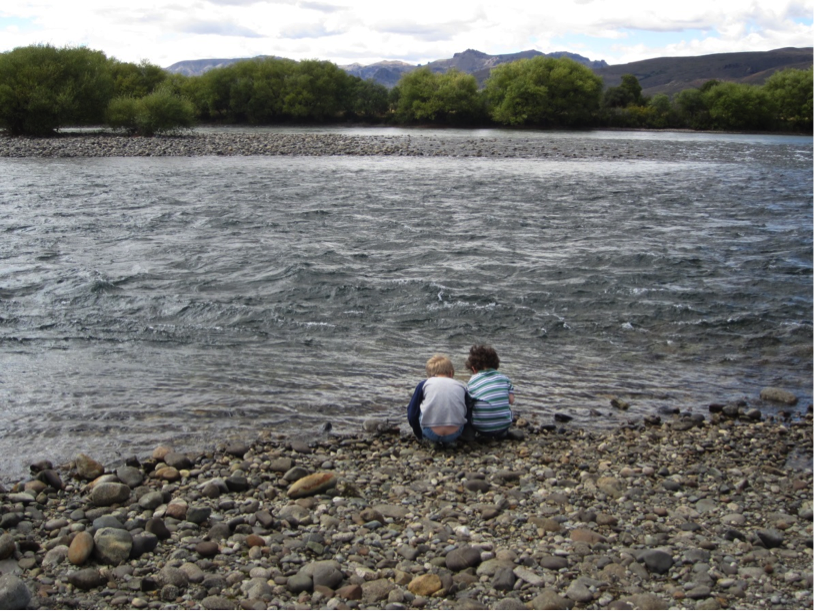
Boys looking for ‘crabs’ along the Limay River, Fortin Chacabuco. Photo ©Dayna Gross/TNC

Fortin Chacabuco is a 12,000-acre ranch about a twenty-minute drive from Bariloche, Argentina.  Bariloche is a picturesque town, called “the gateway to Patagonia.” Located on Lake Nahuel Huapi, it attracts visitors from all over the world who come to see the mountain vistas and enjoy the recreational opportunities of Patagonia.

The Nature Conservancy of Argentina has been here for six years, working on such things as sustainable grazing projects, conservation easements, biological assessments, oil and gas exploration issues and strengthening the Land Trust movement in Argentina. The owners of Fortin Chacabuco have offered to sell the ranch to the Conservancy for a substantially reduced price—offering the chapter a Silver-Creek-like deal of a lifetime. The ranch could be a gateway to the Conservancy for the community, a recreational haven (six miles of river and two smaller trout streams on the property), a place to demonstrate sustainable grazing, an educational center and scientific research station.

Bariloche is located in the rain shadow of the Andes Mountains and therefore receives more rainfall than the surrounding area. The vegetation in and around the city and in the hills is diverse – pines, firs, cotoneasters, roses and spirea.  As you move east, the landscape dries out and from a distance looks very much like Idaho sagebrush steppe.

Limay River which runs along the property line of Fortin Chacabuco. Photo ©Dayna Gross/TNC.

With the similarities in landscape, Fortin Chacabuco and Silver Creek struggle with similar management issues – invasive species, climate change, inadequate grazing buffers, trespass and overuse.  Some things are different, however. Here, the invasive species are rose, willows, and pine – the very plants we often plant for habitat at Silver Creek. Fishing and recreational pressure appear to be less than the Silver Creek area; although, that remains to be seen because we are here during the “slack” season. While we allow for duck hunting at Silver Creek, Fortin Chacabuco will be controlling red deer, rabbit, and wild boar, which are nuisance species in their hunting plan. In Argentina, there is little public land. The national parks compromise approximately 8 percent of the land and they can include “category 6” lands which allow for private land holdings, development, grazing, and other uses. This is compared to more than 60 percent public lands in Idaho. Land ownership itself presents very different challenges and opportunities. Owning a large ranch like Fortin Chacabuco (actually small for Argentina) creates a rare opportunity for the Conservancy to showcase a new way of doing conservation in Argentina and the public benefit of conservation on private lands.

These are the similarities and differences that I notice as a land manager. It is funny to hear the similarities and differences my kids notice as we play this game. This morning we made a list and this is what they came up with:

Same- the trees, the rivers, people, lakes 
Different- Motorcycles, buses, the toilets, the ice cream, more noise, Spanish, street dogs

This is how I think of the Silver Creek and Fortin Chacobuco comparison.  In the end, the big things are the same—the nature, structure, and opportunities. It’s just the specifics and the noisy things that are different.

Monday, March 10, 2014

A Rare Sighting of the Politcal Kind

By Will Whelan, director of government relations

This blog often reports on sightings of rare wildlife at our preserves.

Last week brought a rare sighting of a different kind: all four members of Idaho’s congressional delegation in the same room with Tom Tidwell, Chief of the U.S. Forest Service.  One veteran of Capitol Hill commented that he’d never actually seen Senator Crapo, Senator Risch, Congressman Simpson, and Congressman Labrador in one place before.

Senator Crapo, Senator Risch, Congressman Simpson, Congressman Labrador, and Tom Tidwell. Photo ©Will Whelan/TNC.

Idaho’s congressional leaders and the Forest Service chief did not come together for a major political event or convention.  Instead, they came together to collectively voice their support for collaborative forest restoration at the annual conference of a small but ambitious organization called the Idaho Forest Restoration Partnership.  IFRP’s conference brings together the members of groups that are working on forest restoration across Idaho.  Participants ranged from conservation groups such as The Nature Conservancy, the Idaho Conservation League and Trout Unlimited to timber companies such as Boise Cascade and Idaho Forest Group to rural county commissioners. Just about every interest group that cares about national forests had a representative in the room.  The Conservancy is a founding member of the Partnership and helped organize the conference.

The collaborative groups that met last week in Boise support the use of active forest management, such as thinning and prescribed fire, in the roaded portion of Idaho’s national forests to further ecological, economic and social goals. Many of the projects that these groups helped develop also include measures to improve water quality, decommission old roads, and enhance wildlife habitat.

Last week’s event is a clear sign that collaborative groups are coming of age and earning the kind of support that can help accelerate their work.

You can read Idaho Statesman’s article about last week’s event at: http://www.idahostatesman.com/2014/02/20/3039515/forest-collaboration-draws-attention.html